
CASE STUDY
Travel to Conflict Regions Challenges Students’ Preconceptions
A Vietnamese tour guide speaks with students from UC Berkeley, Chapman University, and the University of Wyoming outside a temple in rural Hanoi, near the iconic Long Biên Bridge, during CIEL's Vietnam and Cambodia program. The program introduces students to the region's layered history, from French colonialism and the Vietnam War to the Khmer Rouge genocide, and examines how Vietnam and Cambodia have approached memory, reconciliation, and transitional justice in the decades since. Photo courtesy of Claudio Dangmann
Civil dialogue, experiential learning, and study abroad are all key components of higher education. What if you could combine them?
One nonprofit that began at the University of California at Irvine has done just that for almost two decades. The experiences have had a powerful influence on participants’ lives.
Kevin Pham arrived at UCI in 2006 “pretty much a lost and confused student,” he remembers. “I partied a lot. I was a skateboarder. I seriously contemplated becoming a tattoo artist.”
His freshman year coincided with a period of widely noted Jewish-Muslim tensions at Irvine. Pham found himself to be a one-man conflict zone, and he struggled to make sense of that. His social circle included members of the Muslim Student Union and the Alpha Epsilon Pi Jewish fraternity. “I constantly had one foot in one world and one in the other.” In addition, Pham’s family members were fiercely anti-Communist refugees from Vietnam, but many of his friends were hard-core Marxists.
His roommate belonged to a student Israel-advocacy group while his best friend at home in San Jose was Palestinian. When Pham went home for winter break, he asked him, “How come we never talk about this?” So they did talk, and Pham learned that in 1948, officials of the newly established Israel had confiscated the friend’s family farmland.
Why couldn’t Pham’s Jewish roommate and Palestinian friend in San Jose connect, share their perspectives, and work through their grievances? “I thought there was a simple misunderstanding,” Pham says. “I took out my laptop. I turned on Skype, and I forced them to talk. They screamed at each other for five hours. It was that night that made me realize how ignorant I was.”
Empathizing with opposing factions had become a theme of Pham’s life, and soon it would become the theme of his education and then his career. That, he says, was thanks to the Olive Tree Initiative.
‘OK TO DISAGREE’
OTI was the brainchild of Daniel Wehrenfennig, who was an Irvine doctoral student in political science. He had come to the United States from his native Germany because his American girlfriend (and future wife), who had grown up in Germany, enrolled at the University of Southern California to study filmmaking. At Irvine, Wehrenfennig was writing a dissertation on how informal communication between citizens could complement formal diplomacy in peacebuilding in Northern Ireland and between Israelis and Palestinians.
What, Wehrenfennig asked, if instead of shouting insults at each other on campus, students went to the Middle East together to see for themselves the realities of conflict zones? Over 18 months, 14 students with varied religious, political, and other backgrounds raised $60,000 to go on a two-week journey in 2008 with Wehrenfennig. Paula Garb, co-founder of Irvine’s Center for Citizen Peacebuilding, which provided key early support for the plan, and Manuel Gómez, the university’s vice chancellor, also joined the group.
The trip to Israel and the Palestinian territories was intense. A jam-packed itinerary included visiting with speakers at mosques, synagogues, churches, burial sites, checkpoints, and refugee camps, followed by periods of reflection and discussion.
“I learned it was OK to disagree, and it was OK to not have the same viewpoint as everyone else, and you can still have a discussion and not hate each other,” Sameera Ali, a UCI senior who belonged to the Muslim Student Union, told the Orange County Register after the experience.
The project had gone well, but Wehrenfennig had a dissertation to finish. Administrators, faculty members, and students kept asking him, “‘When’s the next trip?’ ‘What are you talking about, the next trip?’” he replied. “‘I’m going back to Europe.’”
But he didn’t. Wehrenfennig stayed in the Los Angeles area and was hired by UC Irvine to develop OTI and plan more such experiences, which would include course work before and after the journeys and an emphasis on developing students’ confidence and leadership skills. He and the organization’s tiny staff did so, planning trips not only to the Middle East but to the Caucasus, Colombia, Cuba, and Northern Ireland. As preliminary stops before trips abroad, students would visit the Capitol in Washington and the United Nations in New York. In addition to UCI, student participants came from other UC campuses, and from other colleges and universities.
OTI sunsetted in 2020. The following year, Wehrenfennig and members of its core team established the Center for International Experiential Learning, or CIEL, as an independent nonprofit, separate from the University of California.
CIEL carries forward OTI’s model of rigorous academic preparation, immersive engagement with people across a conflict, and structured post-program reflection. Its roster of 15 institutional partners is growing. Colgate University, University College London, and Vanderbilt University are among the more recent. CIEL has also expanded the model beyond college students to include educators, peacebuilding and civil-society professionals, faith leaders, and policymakers. It works with institutional partners to integrate the travel experiences into courses, research, and professional development.
Daniel Wehrenfennig, executive director of CIEL, leads students from the University of Wyoming and Chapman University through the Old City of Jerusalem during a 2022 summer Middle East program, orienting them to the city's distinct quarters and the cultural, historical, and religious significance of each. The Old City's contested religious sites sit at the center of the region's political and religious tensions, making the area one of the most closely watched flashpoints in Jerusalem. Photo courtesy of Claudio Dangmann

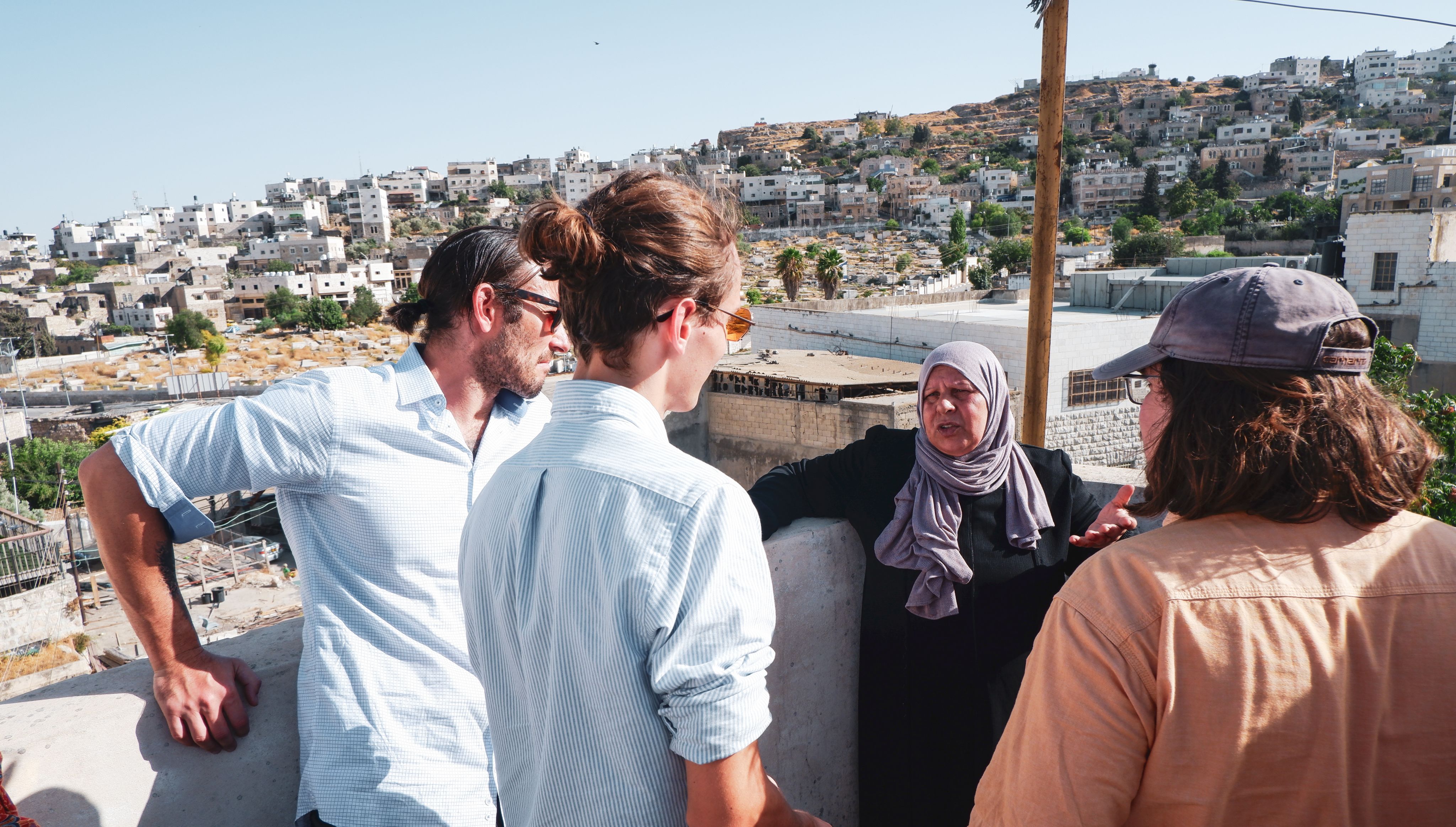
A Palestinian woman briefs students from UC Berkeley and the University of Wyoming on conditions facing the Palestinian community in Hebron, Palestinian Territories, during CIEL's Israel-Palestine program in summer 2023. Hebron residents face frequent friction with Israeli settlers and live under a heavy military presence that shapes daily movement and access throughout the city. Photo courtesy of Claudio Dangmann
A Palestinian woman briefs students from UC Berkeley and the University of Wyoming on conditions facing the Palestinian community in Hebron, Palestinian Territories, during CIEL's Israel-Palestine program in summer 2023. Hebron residents face frequent friction with Israeli settlers and live under a heavy military presence that shapes daily movement and access throughout the city. Photo courtesy of Claudio Dangmann
‘IT CHANGED MY LIFE’
Kevin Pham went on OTI’s second Middle East trip, in 2009. “It changed my life quite literally overnight,” he says.
Pham’s group met with a bereaved Israeli father whose son was killed in a suicide attack, then crossed into the West Bank where a Palestinian mother told them about her son who was killed by an Israeli sniper. Daniel Wehrenfennig led the program, but another Daniel, Daniel Brunstetter, a UC Irvine professor of political science, helped Pham process what he was seeing, hearing, and learning.
Why, Pham asked Brunstetter, can’t these people understand that they need to break the cycle of violence? What would you do, Brunstetter countered, if someone, say, broke into your home and kidnapped your brother? Would you be thinking about disrupting the cycle of violence?
“Your narrative in California,” Brunstetter told him, “is a tiny fraction of the cornucopia of human narrative.”
Dialogue is necessary to begin bridge building, but that notion of not rushing toward a facile, superficial mirage of reconciliation, instead actively listening to competing narratives, has been foundational to OTI and CIEL. “A narratives approach,” Brunstetter and Wehrenfennig have explained, “seeks to unpack the concepts of identity at the heart of intractable conflicts by exploring a multitude of perspectives. … This approach allows the student to better understand the complexities of the conflict.”
“You can study the architecture of a peace process and agreement in a classroom,” says Wehrenfennig. “In the field, you see what it asks of the people and institutions that have to live with it.”
Pham says that skeptics toward such experiences scoff, “You think dialogue can lead to peace.” “No,” he tells them. “That’s not what I think at all. I think dialogue can make students better critical thinkers.”
After that 2009 trip, study with Wehrenfennig and Brunstetter influenced Pham’s path toward a bachelor’s degree in political science from Irvine, a master’s degree in conflict resolution and governance from the University of Amsterdam, and a doctoral degree in political theory and international relations from the University of California at Riverside. Those led to his current position as an associate professor of political theory back at the University of Amsterdam. There he brings in guest speakers, leads class trips to an ethnographic museum, the Wereldmuseum, to explore Dutch colonial history, and incorporates music in the classroom as part of the sensory, experiential, multi-perspective approach he learned from OTI.
Pham wrote a book about Vietnamese political theorists. He helped develop CIEL’s Vietnam-Cambodia program and has acted as facilitator for several of those trips, helping students try to make sense of their experiences the way Brunstetter helped Pham.
“Your narrative in California,” Brunstetter told him, “is a tiny fraction of the cornucopia of human narrative.”
‘VERY EMOTIONALLY HEAVY’
As a student at UCLA, Corey Feinstein was on OTI’s 2011 Middle East trip. “It was such a rich, impactful experience that has informed every step of my life since,” he says.
While he was a student, and then for a couple of years after he graduated, Feinstein was OTI’s associate director. After that first trip, he went on another three OTI journeys, leading one of them. He pitched Wehrenfennig on the preliminary D.C. and New York visits, before students flew to Tel Aviv, to better understand U.S. and U.N. roles in peacebuilding. Wehrenfennig liked the idea and tasked Feinstein with putting it together. When Feinstein asked diplomats, congressional representatives, and think-tank scholars to speak with the students — including prominent figures like Dennis Ross, Robert Malley, and Andrew Gilmour — “everyone I reached out to said yes in a heartbeat.”
Those experiences inspired Feinstein to become a diplomat. He went on to join the Foreign Service and held assignments in Washington and in Venezuela between 2014 and 2017. Since then he’s been executive adviser to two University of California presidents and is now senior director of strategic initiatives for the University of California at San Francisco.
Feinstein says his first OTI program was “quite jarring,” and that was the power of it. “We talk about all these ideas in abstraction. There’s a lot of arguing and positioning based on ideas rather than the real world.” OTI disrupted that. “It brought you out of your environment and into the environment that you talked about, and studied, and argued about. And all of a sudden you realize that you know nothing. … It’s so disarming when ideas become people’s lives.”
“[OTI] brought you out of your environment and into the environment that you talked about, and studied, and argued about. And all of a sudden you realize that you know nothing. … It’s so disarming when ideas become people’s lives.”
The conflict-related stories hit home, he remembers, as did “such amazing access to leaders, to negotiators.” But he was also struck by the fact that even in zones of intractable conflict, people aren’t thinking about that conflict for the majority of their day. A kid is nervous about asking a girl out on a date or wants to buy a guitar to start a band — “people just trying to live their lives.” While the regional history was sinking in, the more immediate revelation, Feinstein recalls, was, “Wow, this world is big. This world is complicated. … I think many of our participants — not just me — also realized by speaking with so many leaders that there were more productive ways to be a good citizen than simply protest, arguing, or creating mini-conflicts on U.S. campuses.”
“I think many of our participants — not just me — also realized by speaking with so many leaders that there were more productive ways to be a good citizen than simply protest, arguing, or creating mini-conflicts on U.S. campuses.”
Karly Redeman, a senior at Chapman University, recently returned from an August CIEL trip to Bosnia and previously had gone with the organization to Vietnam and Cambodia in the winter of 2024-25 and to Northern Ireland in June 2025.
The experiences, she says, instilled confidence but also a sense of responsibility to share what she learned and the importance of understanding conflicts and hard-won reconciliations beyond U.S. borders. She’s a double major in peace and justice studies, and political science, and she’s minoring in women and gender studies. The 21-year-old San Diego native is writing, essentially, three senior theses, even if the third, for her minor, is technically a capstone project. All three are influenced by her CIEL experiences, as are her plans to work in NGOs focused on peacebuilding.
“There are definitely ups and downs on the trips because you’re dealing with very emotionally heavy materials,” she says.
But there is also, she says, hope in the healing. She recalls, on the Northern Ireland journey, a former Irish Republican Army fighter, a former member of the Ulster Defence Association, and a former British soldier, all “sitting, sharing a cup of tea, and laughing over biscuits.”

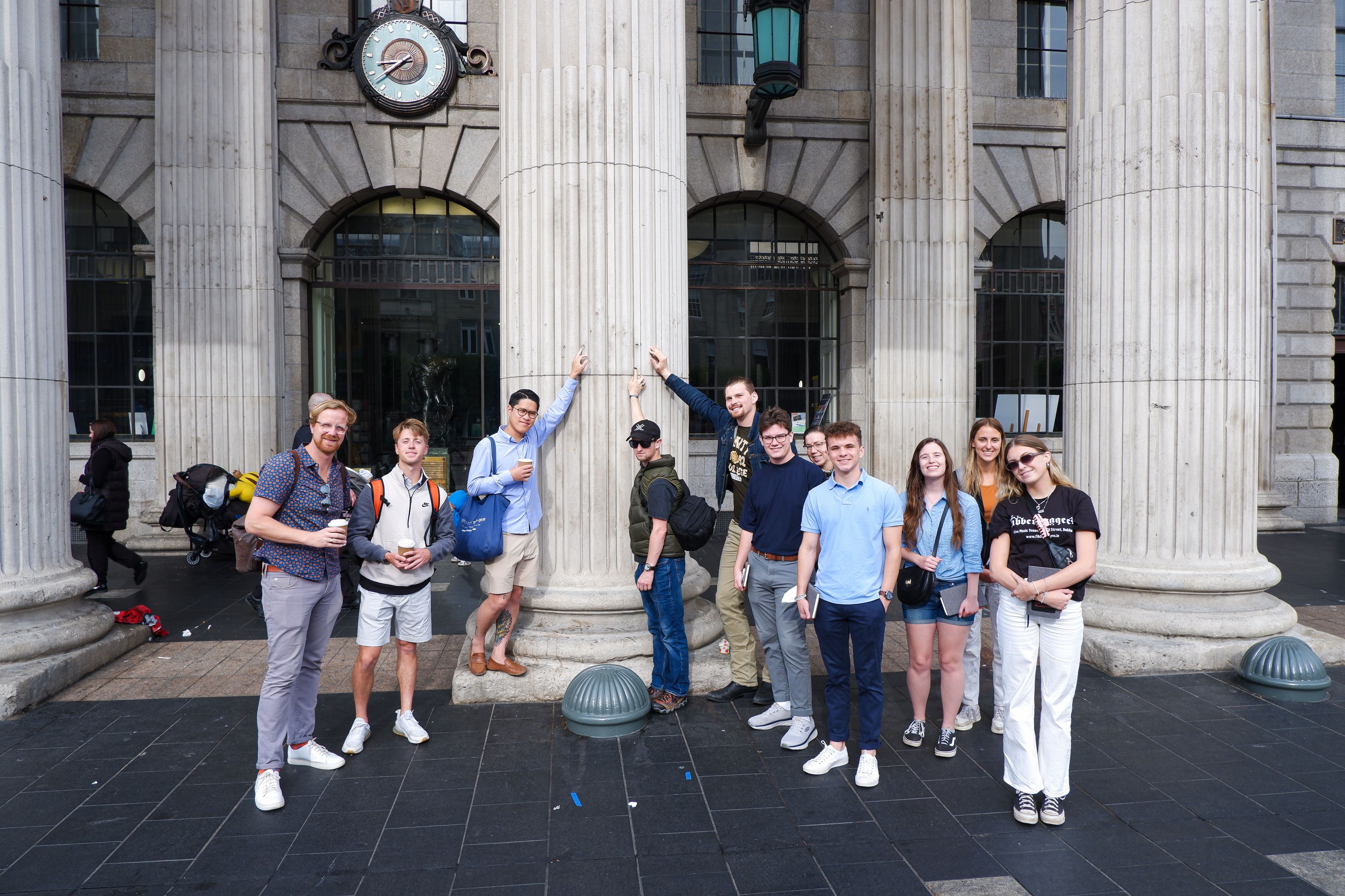
Students and faculty members from the University of Wyoming and Gettysburg College stand in front of the General Post Office in Dublin during CIEL's Northern Ireland and Republic of Ireland program in 2022. The GPO served as the headquarters of the 1916 Easter Rising and remains one of Ireland's most significant sites in the history of the independence movement, a stop that anchors the program's examination of partition, conflict, and peacebuilding across the island. Photo courtesy of Claudio Dangmann
Students and faculty members from the University of Wyoming and Gettysburg College stand in front of the General Post Office in Dublin during CIEL's Northern Ireland and Republic of Ireland program in 2022. The GPO served as the headquarters of the 1916 Easter Rising and remains one of Ireland's most significant sites in the history of the independence movement, a stop that anchors the program's examination of partition, conflict, and peacebuilding across the island. Photo courtesy of Claudio Dangmann
‘WE PROCESSED IT AS A GROUP’
Maia Ferdman went on her first OTI trip to the Middle East as a UCLA student in 2013.
“I remember coming back and being like, ‘Who is right here?’ and realizing I didn’t have to answer that question in such black-and-white terms. The answer could be dynamic and changing.”
Ferdman recalls that on the bus, the students “all got into big arguments, really disagreed about what we were seeing,” but then “ultimately would still be able to go out to a bar and be fine.”
“Nowadays,” she says, “that’s so rare, to be able to argue that profoundly and still be in community with each other.”
Those involved in OTI, CIEL, and civil dialogue generally are sometimes accused of indulging the perspectives of would-be terrorists or oppressors, of listening to false equivalences and historical equivocations. But its deep engagement with people across a broad spectrum, says Ferdman, is a positive, not a negative, feature of CIEL.
“When we heard something particularly painful or challenging on our trip, we processed it as a group,” she says, “in a way that is expertly structured, intentional, and supported. … We used those experiences to help sharpen our own sense of moral clarity and our commitments upon our return. That is what made it so formative. … I’m still processing it to this day.”
“Colleges should prepare students to confront the realities of a complex and unfair world,” she says. Clashing stories, unreliable or offensive narrators, propagandists — “that’s unfortunately how the world is,” she says, and colleges need to prepare students “to be confronted with power differential and political subtext,” to “give them a space to actually talk about it, argue about it, and then actually do something about it.”
Ferdman remains active with CIEL and has joined several recent trips. The 2013 OTI experience pointed her in that direction, she says, and helped shape her career. She is deputy director of UCLA’s Bedari Kindness Institute and director of the university’s Dialogue Across Difference Initiative.
Students from Chapman University and the University of Miami study names and family relations recorded at the Srebrenica-Potočari Memorial and Cemetery for the Victims of the 1995 Genocide during CIEL's Bosnia and Herzegovina program in summer 2026. The memorial holds the remains of more than 6,000 victims of the July 1995 genocide, in which Bosnian Serb forces killed more than 8,000 Bosniak men and boys. Through visits to the memorial and meetings with survivors, local historians, and civil society leaders in Sarajevo, Srebrenica, and Mostar, students examine the causes and legacy of the Bosnian War and the ongoing work of transitional justice and reconciliation in the region. Photo courtesy of Claudio Dangmann
‘A PYRAMID OF CHANGE’
More than 800 students have gone on OTI or CIEL trips. Many, says Wehrenfennig, are in influential positions in government, nongovernmental organizations, or academe, but all of them carry their trip experiences forward into their work and their lives. He calls the growing roster of alumni “a pyramid of change.”
At age 47, Wehrenfennig says, he has a wider lens on history than when he started OTI. Less abstract to him now are academic explanations of the way the first generation after historical trauma tends to be silent, the next wants to build a normal life, and the third starts digging into much of the post-conflict work. That third generation asks what grandma and grandpa were doing during the time of tumult. In Germany, that’s his generation, says Wehrenfennig.
Peacebuilding is often a Sisyphean task. “I have many moments of throwing my hands up and feeling despair,” says UCLA’s Ferdman. “The polarization that we’re living in nowadays is even worse than it was 13 years ago” when she went on her first OTI trip. “It is more fraught. It is more divided. It is more risky to dissent in any context.” But like other OTI and CIEL alumni, she says, “I know that it doesn’t have to be that way. I have an alternative vision of what’s possible.”
Peacebuilding is often a Sisyphean task. “I have many moments of throwing my hands up and feeling despair.”
“People who work in conflict do burn out,” says Corey Feinstein. After the October 7 attacks, he called Wehrenfennig and said the OTI/CIEL alumni network’s online postings were quite charged. “Did we fail?” the alumni were asking. “What’s going on here?”
“During active wars,” Wehrenfennig told Feinstein, “this is to be expected. People retreat to their tribes.” But that doesn’t change the fact that relationships have been established, and “at some point, the discourse is ready to happen again. What other choice is there?”
On the recent Bosnia trip, Wehrenfennig was struck by preserved war ruins riddled with bullet holes amid the mostly rebuilt, renovated, renewed region. The trauma is real but “history moves on,” he says. “Things do change.”
Wehrenfennig doesn’t go on every OTI and CIEL trip, but he’s been on 60 to 70 — he’s lost count. “It’s so easy to get lost in that suffering and destruction,” he has found, “but also to underestimate the human spirit.”
“Travel to Conflict Regions Challenges Students’ Preconceptions” was written by Alexander C. Kafka. The Chronicle is fully responsible for the report’s editorial content. ©2026 by The Chronicle of Higher Education Inc. All rights reserved. This material may not be reproduced without prior written permission of The Chronicle. For permission requests, contact us at copyright@chronicle.com.
 Built with Shorthand