



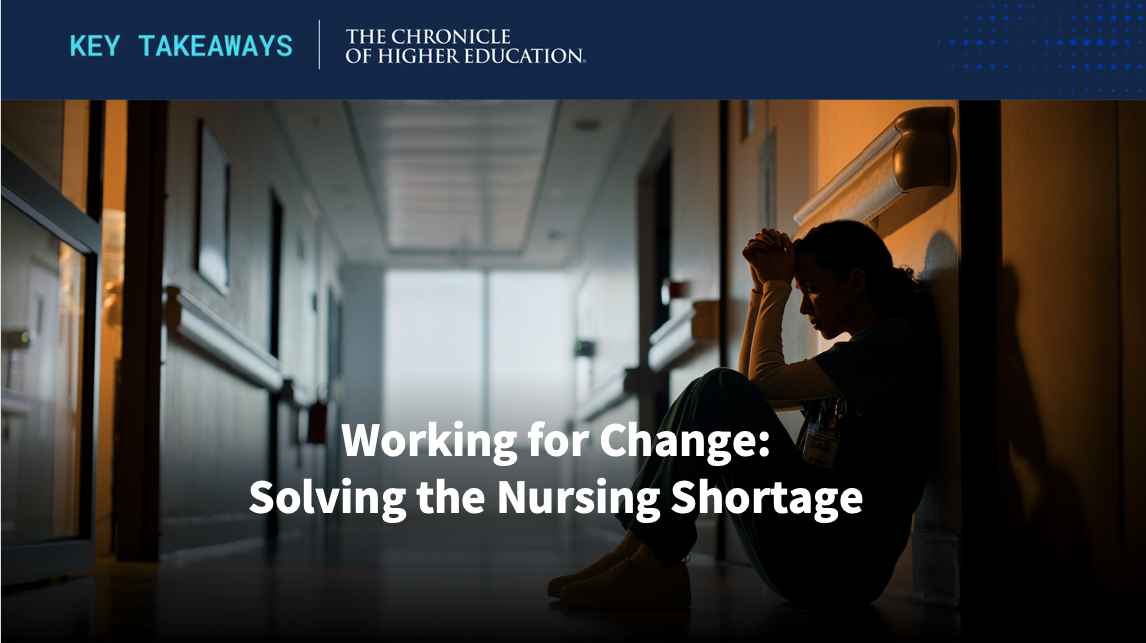
Nursing is one of many professions where turnover is high and job openings exceed the number of new graduates.
Los Angeles County, for example, had nearly 5,000 open registered-nurse positions but produced only 4,400 graduates last year. In response, local higher-ed institutions united to develop a strategy to fill these critical positions.
Spearheaded by Compton College and California State University, the program grew to include the Los Angeles Regional Consortium, which consists of all 19 community colleges in the county.
To discuss higher ed’s role in combating the nursing shortage, The Chronicle held a virtual forum on February 24 called “Working for Change: Solving the Nursing Shortage,” moderated by Keith Curry, president of Compton College, and Ian Wilhelm, a Chronicle deputy managing editor.
Looking at the Los Angeles region as an example, Curry and Wilhelm asked Nathan Evans, associate vice chancellor for academic affairs at California State University’s Office of the Chancellor, and Kenyatta Lovett, a principal with Education Strategy Group, a higher-ed consulting firm, to kick off the forum with presentations about their work for the Los Angeles County 2035 “Nursing Initiative Report.” The panel then continued the discussion, exploring how higher-education institutions can collaborate with local officials and other industry stakeholders to actively help solve this problem, what colleges can do to engage with other institutions to coordinate a regional approach to solve work-force shortages, and how higher education can develop a long-term strategy to help solve the nursing shortage.
The following comments, edited for clarity and length, represent key takeaways from the forum. To hear the full discussion, watch the recorded webinar here.


Ian Wilhelm (co-moderator)
Deputy Managing Editor
The Chronicle of Higher Education
Keith Curry (co-moderator)
President
Compton College

Erika D. Beck
President
California State University at Northridge

Nathan Evans
Associate Vice Chancellor of Academic Affairs
California State University, Office of the Chancellor

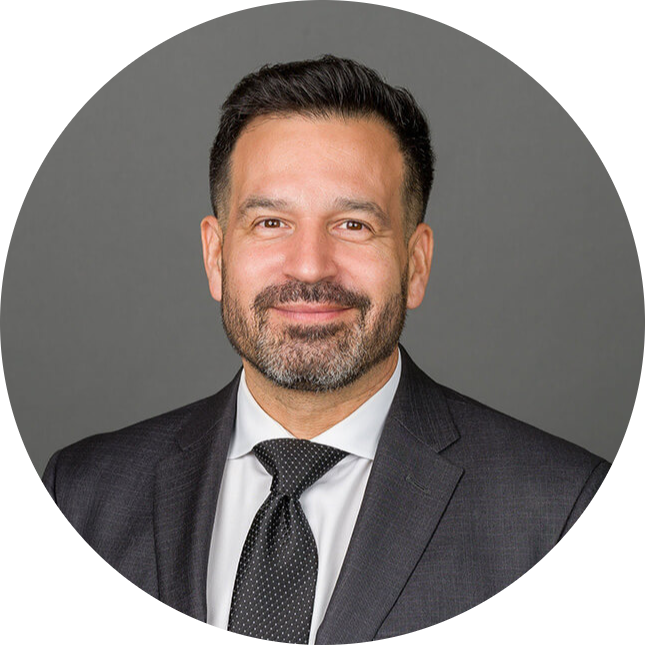
Jose L. Fierro
President and Superindendent
Cerritos College

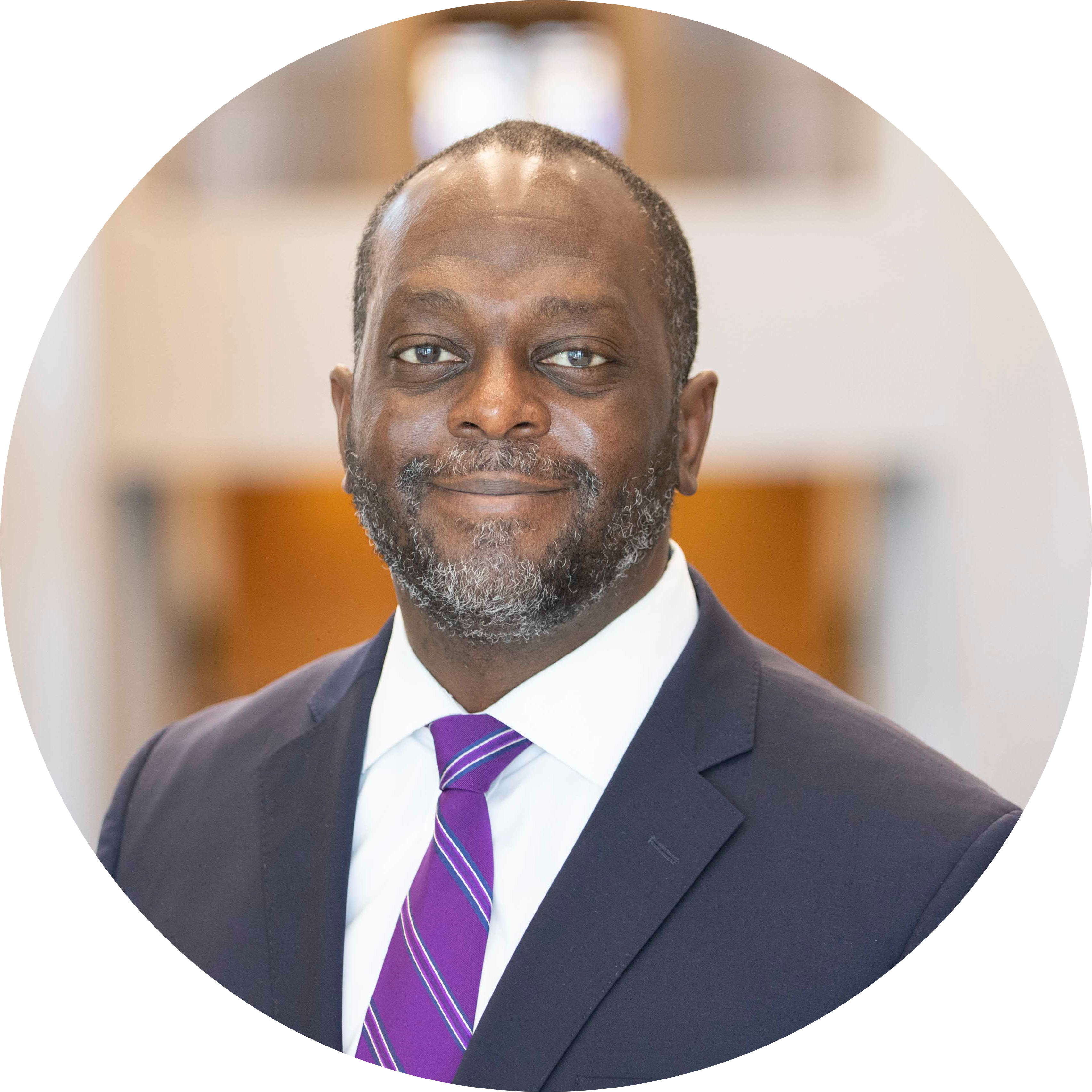
Kenyatta Lovett
Principal
Education Strategy Group


Narineh Makijan
Chair and Assistant Vice President
Los Angeles Regional Consortium (LARC)


Ian Wilhelm: This is more than just a capacity issue — what is it that you're trying to tackle here that's more systematic?
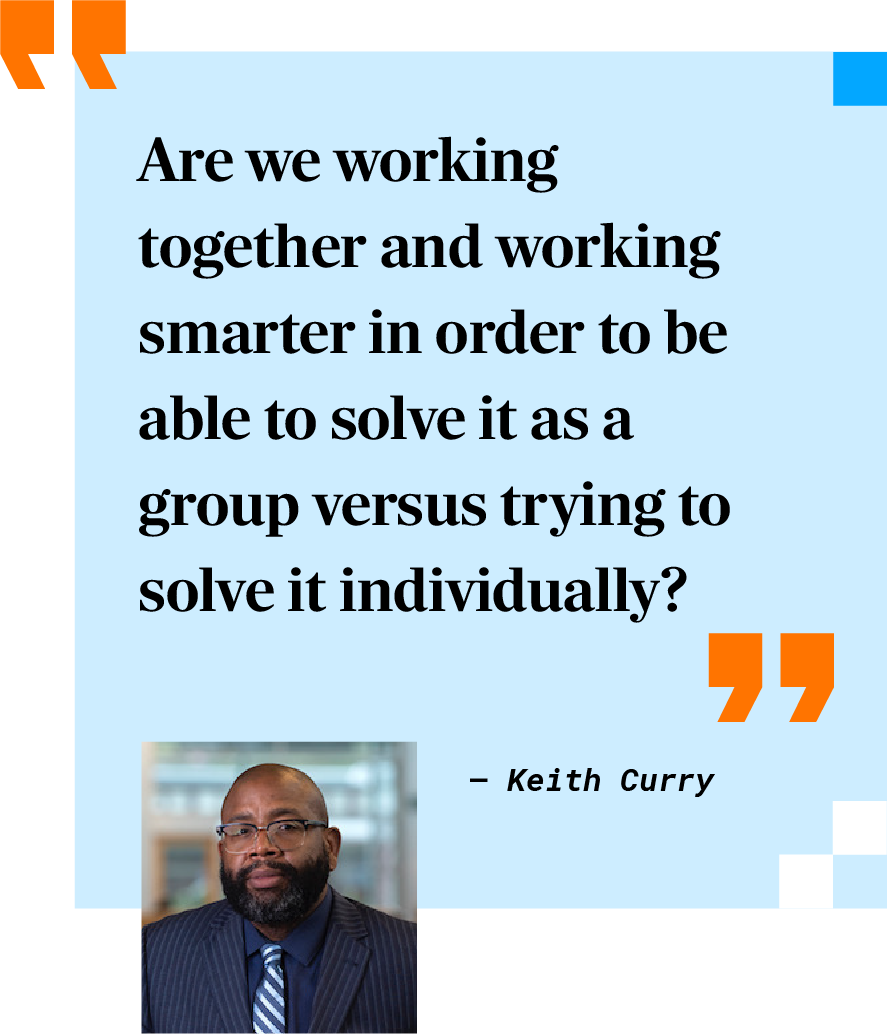
Keith Curry: The biggest issue is the amount of silos you have when you tackle big problems — you have the California State University system, the University of California, the four-year systems, community colleges that are doing good work in this area. You have hospitals who are trying to address this as well. But are we working together and working smarter in order to be able to solve it as a group versus trying to solve it individually?
Also, how do you align the resources to do this work? You have to bring all the people to the table, but also you have to align resources, because one source of funding can't solve the problem. I'm hopeful that this could be a model not only for nursing across the country, but also for how to develop partnerships with the industry, with the four-year colleges, community colleges, and K-12, to address big problems.
We have to be able to build relationships and friendships to attack these big problems, and we can tackle them together, because there's trust.
Wilhelm: We're also going to talk about accountability. Why do you think that is important for this conversation — and perhaps more broadly — as we do face some skepticism around higher education?
Curry: It's important to hold institutions accountable for student success but also for return on investment and economic mobility. We want to make sure students who are going through our programs are able to get jobs and are making livable wages. At Compton College we have a partnership with St. John's Community Health, and we're working to build a 24/7 urgent-care facility on our campus — a 24/7 urgent-care facility on a community-college campus is unheard of, right? We have funding to build that facility, but it's important to think about accountability, about employment opportunities for our students, and then we can articulate that to our community and to potential students to say, these are the job opportunities that we have for you once you complete your program.


Ian Wilhelm: This is more than just a capacity issue — what is it that you're trying to tackle here that's more systematic?
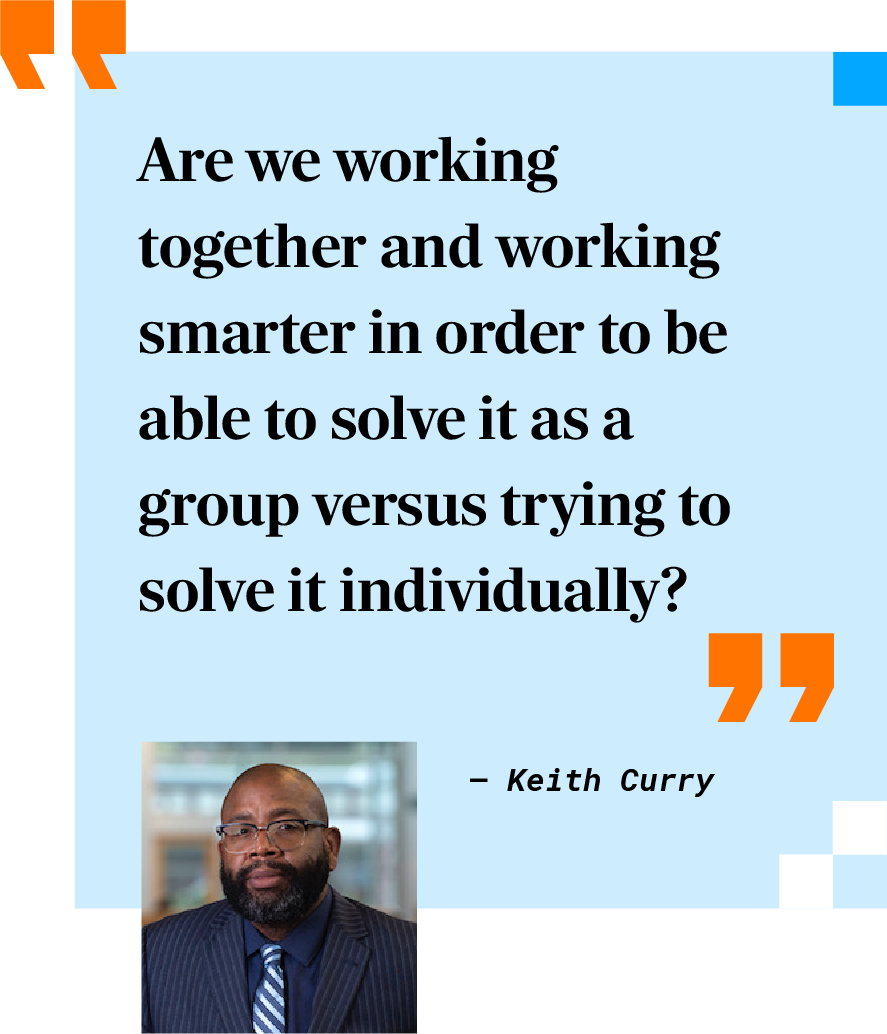
Keith Curry: The biggest issue is the amount of silos you have when you tackle big problems — you have the California State University system, the University of California, the four-year systems, community colleges that are doing good work in this area. You have hospitals who are trying to address this as well. But are we working together and working smarter in order to be able to solve it as a group versus trying to solve it individually?
Also, how do you align the resources to do this work? You have to bring all the people to the table, but also you have to align resources, because one source of funding can't solve the problem. I'm hopeful that this could be a model not only for nursing across the country, but also for how to develop partnerships with the industry, with the four-year colleges, community colleges, and K-12, to address big problems.
We have to be able to build relationships and friendships to attack these big problems, and we can tackle them together, because there's trust.
Wilhelm: We're also going to talk about accountability. Why do you think that is important for this conversation — and perhaps more broadly — as we do face some skepticism around higher education?
Curry: It's important to hold institutions accountable for student success but also for return on investment and economic mobility. We want to make sure students who are going through our programs are able to get jobs and are making livable wages. At Compton College we have a partnership with St. John's Community Health, and we're working to build a 24/7 urgent-care facility on our campus — a 24/7 urgent-care facility on a community-college campus is unheard of, right? We have funding to build that facility, but it's important to think about accountability, about employment opportunities for our students, and then we can articulate that to our community and to potential students to say, these are the job opportunities that we have for you once you complete your program.

Wilhelm: So let's talk a little bit more about partnerships that you're working with.
Nathan Evans: To give some context, Los Angeles County is home to nearly 10 million people. There are 19 community colleges, five California State University campuses, one University of California campus, and 35 nonprofit universities just in L.A. County, as well as some private for-profit institutions. Navigating that ecosystem is no easy task.
We need to make our transfer pathways as seamless as possible. The opportunity for intervention is in that pipeline. The process identified a variety of solutions that only regional collaboration can accomplish — bringing together faculty members from our community colleges, our CSU campuses, our independent institutions — to think collectively about curriculum, standardizing as much as possible what those expectations for transfer and prerequisites are, and building on some shared learning outcomes to align those competencies and clinical expectations.
Even when our academic pathways are aligned, students aren't going to make progress without clinical placements. Clinical bottlenecks are the most significant constraint to nursing programs and new degree completion. If each institution is competing independently for the same hospital sites, we're duplicating outreach, we're straining our relationships with employers, and we're ultimately limiting the total student capacity.
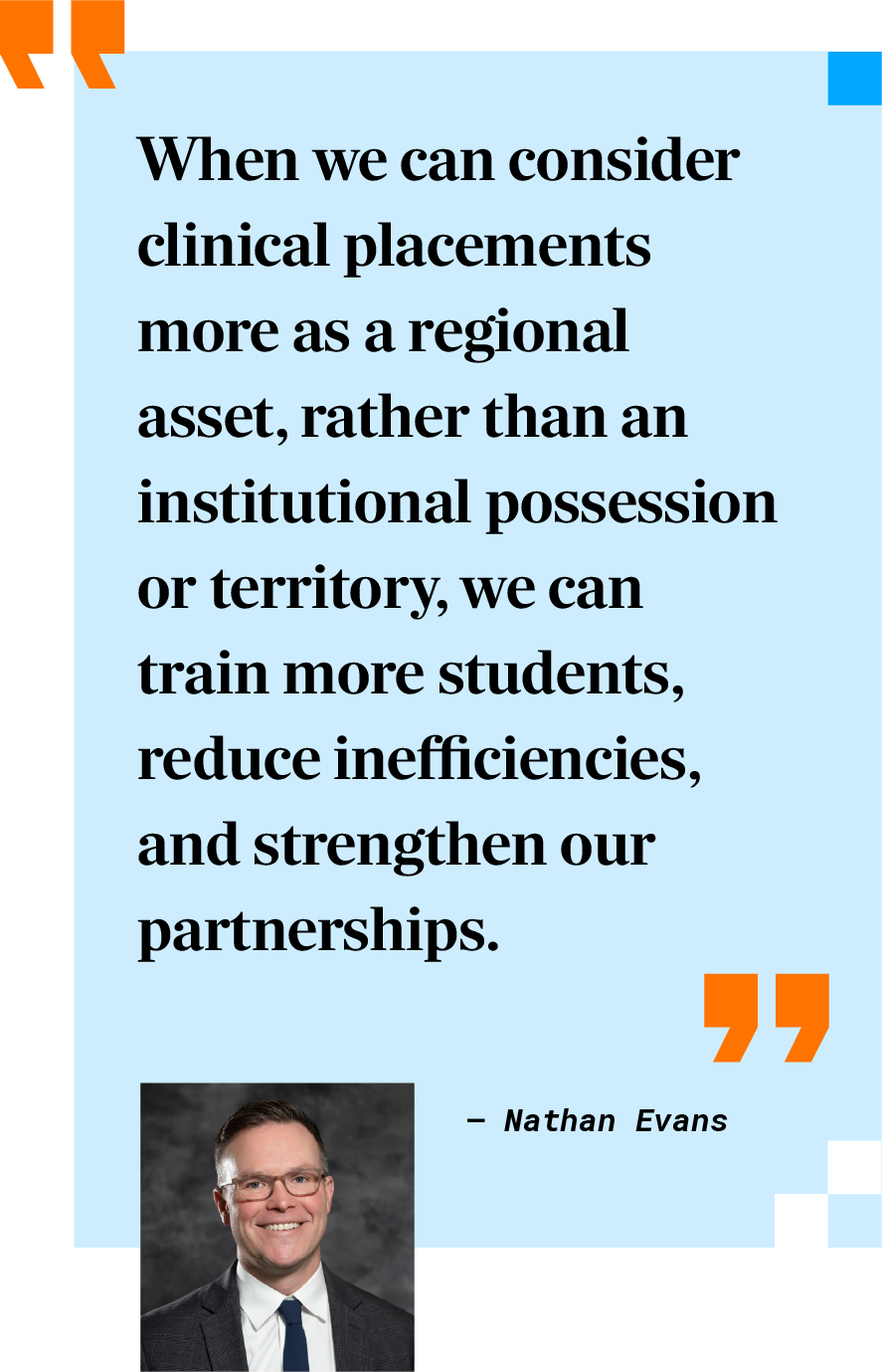
And so, the report outlined the need for regional coordination, which includes sharing coordination of clinical-site requests, coordinating a unified placement schedule and agreements, and some strategic expansion into other sites, like outpatient and behavioral-health settings. When we can consider clinical placements more as a regional asset, rather than an institutional possession or territory, we can train more students, reduce inefficiencies, and strengthen our partnerships.
We have to engage employers at a system level. They're not just recipients of our graduates; they're partners in designing work-force and educational opportunities. Having information from our work-force partners to inform curricular alignment and ultimately expand more placements is key, and our partners benefit from more predictable, coordinated engagement rather than fragmented outreach from multiple institutions.
Finally, we have to make a shared commitment to accountability and establish some common metrics. The coordination requires a lot more sharing of data and shared outcomes. We are creating new dashboards and structures. And ultimately as we improve student progression and time to completion, that'll also help with accreditation alignment and graduate throughput. We already know that national accreditation can play a central role in strengthening quality and graduate mobility, so we have these external accountability metrics that help us identify where our shortcomings are — where students are stalling, where units are accumulating unnecessarily, where some remaining clinical shortages exist, and where we still have opportunities to align gaps.
Kenyatta Lovett: We interviewed employers, nurses, nursing students, community leaders, and institutions to get behind what's at the heart of the supply-and-demand balance that needs to be rectified within the L.A. County region.
When we dove into the data, we realized that the demand for nurses is balanced between new graduates and experienced nurses. It was difficult for entry-level grads to get jobs, but also it's a challenge for our employers to think about how to make sure that they have the right balance of talent within their organizations and at their hospitals. Production of nurses was close to sufficient, but turnover and retention remain major challenges for employers. Also, the distribution of nursing slots is increasingly dominated by private institutions — what can we do through policy, through other measures to make sure that there's access and opportunity? Most community-college students are not transferring to four-year colleges, so we do need to reduce transfer friction.

Wilhelm: So let's talk a little bit more about partnerships that you're working with.
Nathan Evans: To give some context, Los Angeles County is home to nearly 10 million people. There are 19 community colleges, five California State University campuses, one University of California campus, and 35 nonprofit universities just in L.A. County, as well as some private for-profit institutions. Navigating that ecosystem is no easy task.
We need to make our transfer pathways as seamless as possible. The opportunity for intervention is in that pipeline. The process identified a variety of solutions that only regional collaboration can accomplish — bringing together faculty members from our community colleges, our CSU campuses, our independent institutions — to think collectively about curriculum, standardizing as much as possible what those expectations for transfer and prerequisites are, and building on some shared learning outcomes to align those competencies and clinical expectations.
Even when our academic pathways are aligned, students aren't going to make progress without clinical placements. Clinical bottlenecks are the most significant constraint to nursing programs and new degree completion. If each institution is competing independently for the same hospital sites, we're duplicating outreach, we're straining our relationships with employers, and we're ultimately limiting the total student capacity.
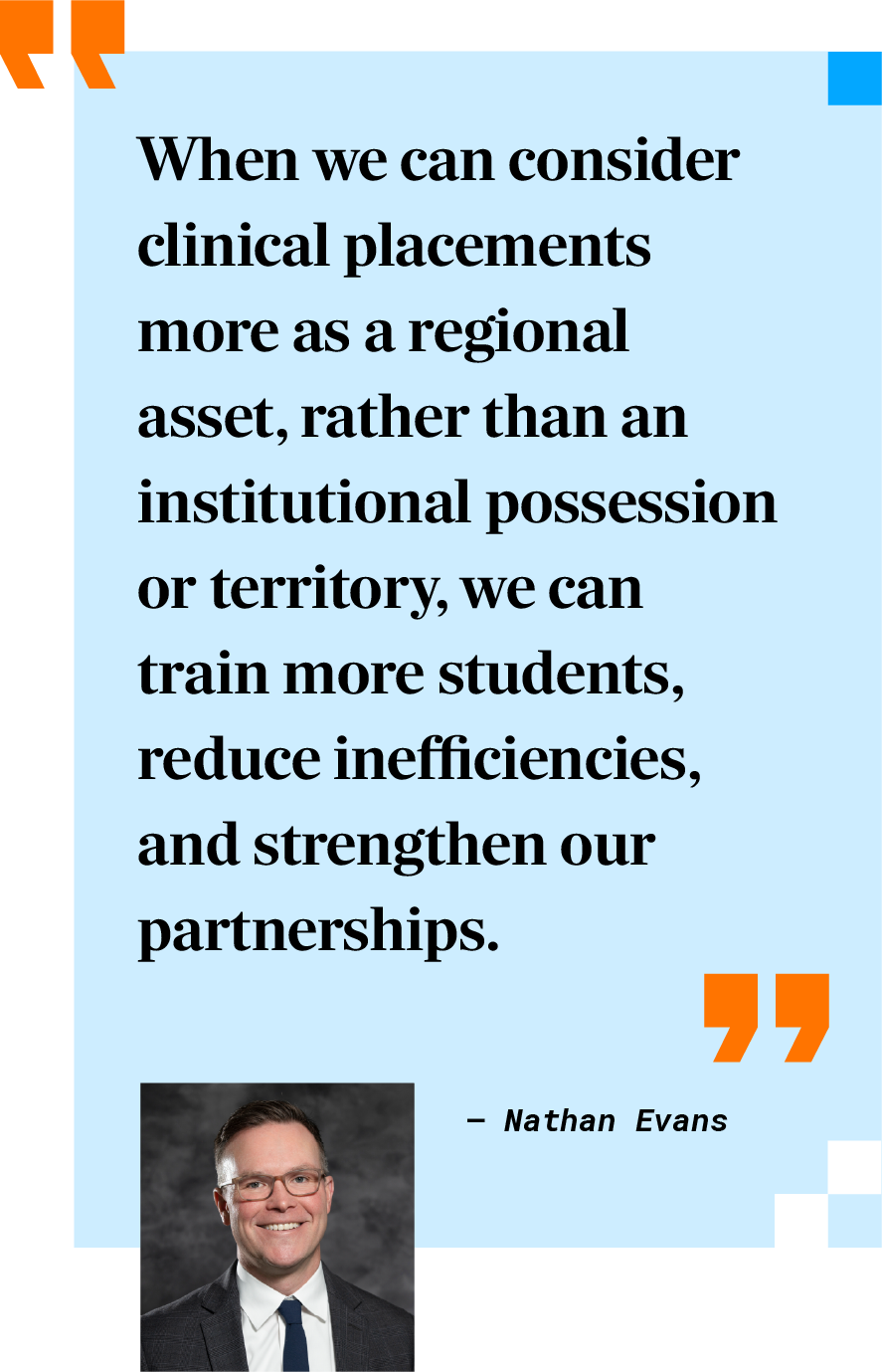
And so, the report outlined the need for regional coordination, which includes sharing coordination of clinical-site requests, coordinating a unified placement schedule and agreements, and some strategic expansion into other sites, like outpatient and behavioral-health settings. When we can consider clinical placements more as a regional asset, rather than an institutional possession or territory, we can train more students, reduce inefficiencies, and strengthen our partnerships.
We have to engage employers at a system level. They're not just recipients of our graduates; they're partners in designing work-force and educational opportunities. Having information from our work-force partners to inform curricular alignment and ultimately expand more placements is key, and our partners benefit from more predictable, coordinated engagement rather than fragmented outreach from multiple institutions.
Finally, we have to make a shared commitment to accountability and establish some common metrics. The coordination requires a lot more sharing of data and shared outcomes. We are creating new dashboards and structures. And ultimately as we improve student progression and time to completion, that'll also help with accreditation alignment and graduate throughput. We already know that national accreditation can play a central role in strengthening quality and graduate mobility, so we have these external accountability metrics that help us identify where our shortcomings are — where students are stalling, where units are accumulating unnecessarily, where some remaining clinical shortages exist, and where we still have opportunities to align gaps.
Kenyatta Lovett: We interviewed employers, nurses, nursing students, community leaders, and institutions to get behind what's at the heart of the supply-and-demand balance that needs to be rectified within the L.A. County region.
When we dove into the data, we realized that the demand for nurses is balanced between new graduates and experienced nurses. It was difficult for entry-level grads to get jobs, but also it's a challenge for our employers to think about how to make sure that they have the right balance of talent within their organizations and at their hospitals. Production of nurses was close to sufficient, but turnover and retention remain major challenges for employers. Also, the distribution of nursing slots is increasingly dominated by private institutions — what can we do through policy, through other measures to make sure that there's access and opportunity? Most community-college students are not transferring to four-year colleges, so we do need to reduce transfer friction.
Curry: What does leadership look like in a work-force crisis?
Erika D. Beck: A big part of it is learning how to be an enabler and not a bottleneck. Our role is in understanding the barriers and helping to try to remove some of those barriers. [Having] a genuine regional perspective — that can be hard to do, because our institutions have all been historically in our own little worlds. For presidents and for leadership, it's showing up when it matters. I spend a lot of time with my community-college partners, in economic-development forums, with the hospitals and health-care facilities, showing up in Sacramento.
Wilhelm: What are the challenges that you had internally?
Jose L. Fierro: We want to make sure that the collaboration that already exists across our campus is amplified, provide the forum for our faculty to be able to provide ideas, voice their concerns, and lead into collaboration. I don't see the issues that we're having to be of internal nature. What I see is for us to be able to look outside the window, and rather to see a competitor, see someone that we can partner with and grow together.
Curry: The pay for nurses in higher education, that's an issue. Paying them above the market value so they can be able to live sustainably is difficult. Some nurses are not taking jobs in higher education because of the pay, and that has to be addressed as we move forward.
Beck: I really agree. The faculty shortage in nursing is a real problem. We do need additional resources.




Curry: What does leadership look like in a work-force crisis?
Erika D. Beck: A big part of it is learning how to be an enabler and not a bottleneck. Our role is in understanding the barriers and helping to try to remove some of those barriers. [Having] a genuine regional perspective — that can be hard to do, because our institutions have all been historically in our own little worlds. For presidents and for leadership, it's showing up when it matters. I spend a lot of time with my community-college partners, in economic-development forums, with the hospitals and health-care facilities, showing up in Sacramento.
Wilhelm: What are the challenges that you had internally?
Jose L. Fierro: We want to make sure that the collaboration that already exists across our campus is amplified, provide the forum for our faculty to be able to provide ideas, voice their concerns, and lead into collaboration. I don't see the issues that we're having to be of internal nature. What I see is for us to be able to look outside the window, and rather to see a competitor, see someone that we can partner with and grow together.
Curry: The pay for nurses in higher education, that's an issue. Paying them above the market value so they can be able to live sustainably is difficult. Some nurses are not taking jobs in higher education because of the pay, and that has to be addressed as we move forward.
Beck: I really agree. The faculty shortage in nursing is a real problem. We do need additional resources.

Wilhelm: Can you share one partnership mistake to avoid when seeking to expand work-force opportunities?
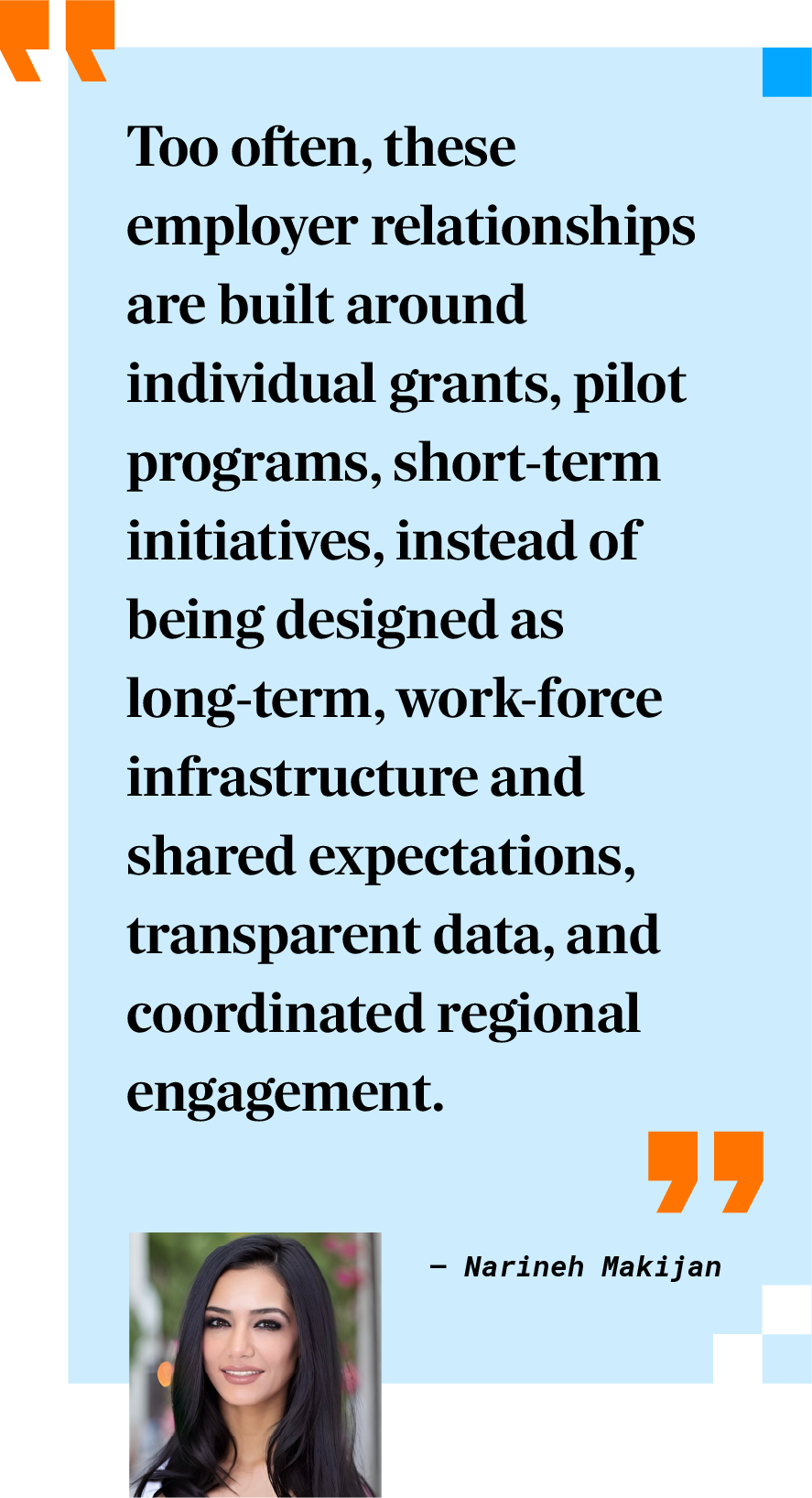
Narineh Makijan: The biggest mistake is treating partnerships as transactional rather than structural. Too often, these employer relationships are built around individual grants, pilot programs, short-term initiatives, instead of being designed as long-term, work-force infrastructure and shared expectations, transparent data, and coordinated regional engagement. This approach leads to duplication, inconsistent communication with employers, and missed opportunities to scale. Sustainable partnerships don't come from isolated agreements. They require system-level coordination, regional alignment, and a shared commitment to outcomes.
Beck: We've got to figure out more systemic ways of decreasing the distance between our faculty and our employers so that curriculum can be shaped in real time, so we can understand the challenges that our employment partners and that the work-force is facing longer term.
Curry: You can't assume the solution. Let the partners, industry, the nursing faculty, and the college presidents be involved in the conversation, and let the process play out.

Wilhelm: Can you share one partnership mistake to avoid when seeking to expand work-force opportunities?
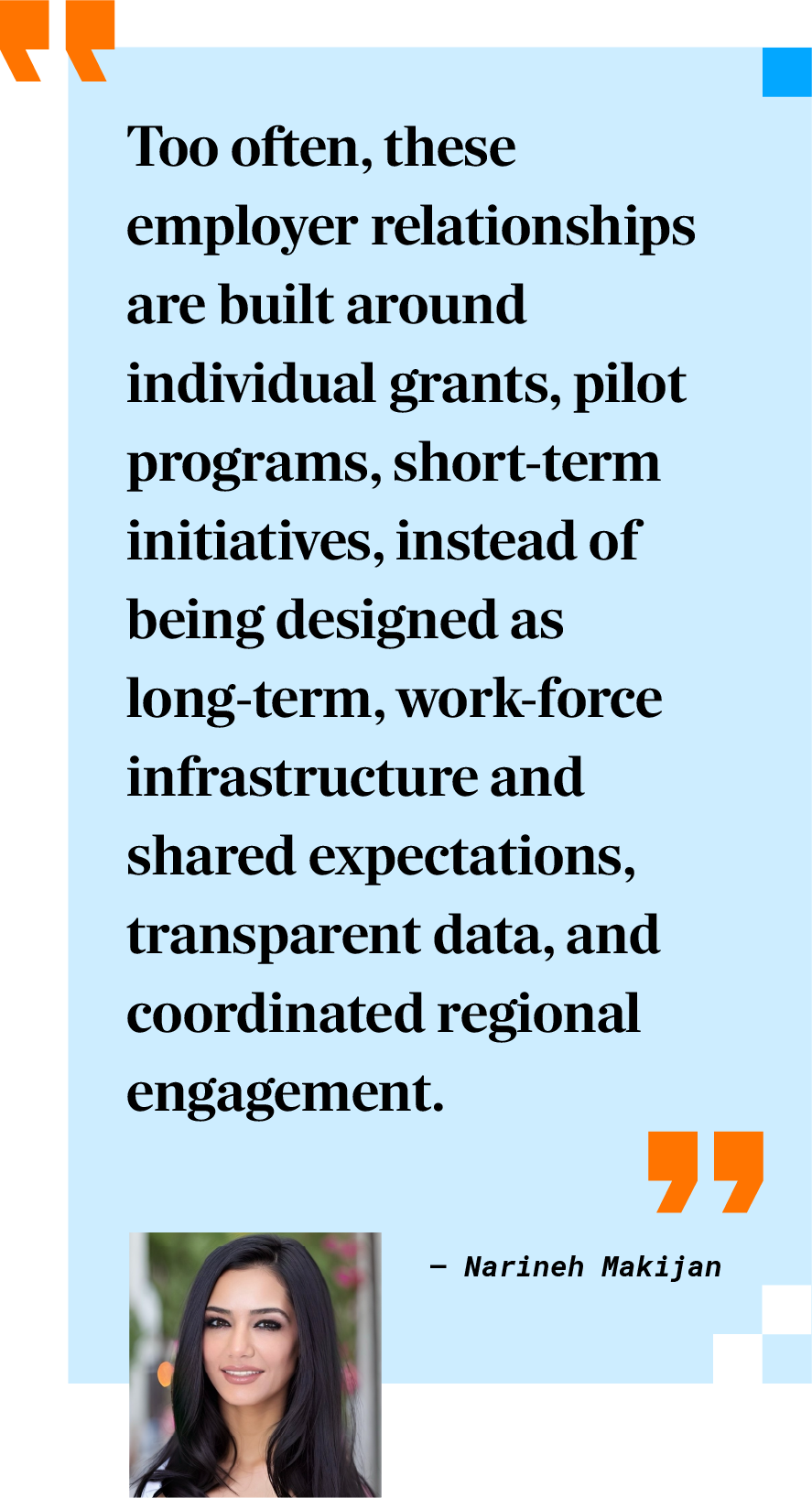
Narineh Makijan: The biggest mistake is treating partnerships as transactional rather than structural. Too often, these employer relationships are built around individual grants, pilot programs, short-term initiatives, instead of being designed as long-term, work-force infrastructure and shared expectations, transparent data, and coordinated regional engagement. This approach leads to duplication, inconsistent communication with employers, and missed opportunities to scale. Sustainable partnerships don't come from isolated agreements. They require system-level coordination, regional alignment, and a shared commitment to outcomes.
Beck: We've got to figure out more systemic ways of decreasing the distance between our faculty and our employers so that curriculum can be shaped in real time, so we can understand the challenges that our employment partners and that the work-force is facing longer term.
Curry: You can't assume the solution. Let the partners, industry, the nursing faculty, and the college presidents be involved in the conversation, and let the process play out.
This Key Takeaways was produced by Chronicle Intelligence. Please contact CI@chronicle.com with questions or comments.
©2026 by The Chronicle of Higher Education Inc. All rights reserved. This material may not be reproduced without prior written permission of The Chronicle. For permission requests, contact us at copyright@chronicle.com.


 Built with Shorthand