
Rebuilding Public Trust and Developing Tomorrow's Leaders
Key Takeaways From an International Higher-Ed Summit
Rebuilding Public Trust and Developing Tomorrow's Leaders
Key Takeaways From an International Higher-Ed Summit
Founded in 1451 by papal bull, the University of Glasgow — the fourth-oldest university in the United Kingdom — has educated inventors, innovators, economists, scientists, politicians, and poets. As part of its 575th anniversary celebrations, the university hosted the Annual Network Meeting & Leadership Summit 2026 of Universitas 21 (U21), a global network of research-intensive universities. Convening over 150 senior university leaders, policymakers, and sector experts from six continents, the event took place on April 20 through 23.
The medieval-style architecture of the university’s setting, evoking more than five centuries of institutional continuity and societal impact, underscored the questions at the heart of the gathering: What is the role of universities in volatile and unpredictable times? And how can universities best serve their students, their communities, and the broader public as the pace of change continues to accelerate and pressures intensify?
“What is clear,” said David Garza, chair of Universitas 21 and president of Tecnológico de Monterrey, in Mexico, “is that no institution alone can navigate these complexities.” Andy Schofield, the principal and vice-chancellor of Glasgow, pointed to the university’s founder and first chancellor, William Turnbull, who was educated in Scotland, Belgium, and Italy, as a historical example of “the importance of international networks [and] learning from what is great in others.”
While the specifics vary by country and context, institutions in America and abroad share similar challenges: funding pressures, demographic shifts, changing public perceptions and student expectations, concerns over equity and access, technological disruption, and deepening geopolitical tensions and fragmentation.
Here are some of the key takeaways from two of the sessions. Some of the comments have been lightly edited for clarity and length.
Founded in 1451 by papal bull, the University of Glasgow — the fourth-oldest university in the United Kingdom — has educated inventors, innovators, economists, scientists, politicians, and poets. As part of its 575th anniversary celebrations, the university hosted the Annual Network Meeting & Leadership Summit 2026 of Universitas 21 (U21), a global network of research-intensive universities. Convening over 150 senior university leaders, policymakers, and sector experts from six continents, the event took place on April 20 through 23.
The medieval-style architecture of the university’s setting, evoking more than five centuries of institutional continuity and societal impact, underscored the questions at the heart of the gathering: What is the role of universities in volatile and unpredictable times? And how can universities best serve their students, their communities, and the broader public as the pace of change continues to accelerate and pressures intensify?
“What is clear,” said David Garza, chair of Universitas 21 and president of Tecnológico de Monterrey, in Mexico, “is that no institution alone can navigate these complexities.” Andy Schofield, the principal and vice-chancellor of Glasgow, pointed to the university’s founder and first chancellor, William Turnbull, who was educated in Scotland, Belgium, and Italy, as a historical example of “the importance of international networks [and] learning from what is great in others.”
While the specifics vary by country and context, institutions in America and abroad share similar challenges: funding pressures, demographic shifts, changing public perceptions and student expectations, concerns over equity and access, technological disruption, and deepening geopolitical tensions and fragmentation.
Here are some of the key takeaways from two of the sessions. Some of the comments have been lightly edited for clarity and length.
Earning Social License
A recent Gallup-Lumina Foundation survey found that Americans’ faith in higher ed has grown for the first time since 2015, with 42 percent of respondents saying they have “a great deal” or “quite a lot of” confidence in the sector, up from 36 percent in each of the past two years. That good news, however, comes with a caveat: American colleges and universities have been contending with declining public trust for over a decade, and the broader picture remains sobering: The figure remains well below the 57 percent recorded in 2015, and a 2025 Pew Research Center survey found that 70 percent of Americans believe higher education in the United States is headed in the wrong direction — up from 56 percent in 2020.
Many international institutions are also facing increased scrutiny over the value of the degree, and grappling with the fact that their legitimacy rests not only on rankings or research success, but on how well — and transparently — they are demonstrating their public value and local accountability. In the session, “Earning Social License: Universities as Civic Powerhouses in a Distrustful Age,” Rachel Sandison, deputy vice-chancellor for external engagement at the University of Glasgow, defined social license as “the ongoing, informal acceptance or approval” of an institution’s practices by “local communities, stakeholders, and the public.” That license, she said, cannot be assumed and must be earned.
Earning Social License
A recent Gallup-Lumina Foundation survey found that Americans’ faith in higher ed has grown for the first time since 2015, with 42 percent of respondents saying they have “a great deal” or “quite a lot of” confidence in the sector, up from 36 percent in each of the past two years. That good news, however, comes with a caveat: American colleges and universities have been contending with declining public trust for over a decade, and the broader picture remains sobering: The figure remains well below the 57 percent recorded in 2015, and a 2025 Pew Research Center survey found that 70 percent of Americans believe higher education in the United States is headed in the wrong direction — up from 56 percent in 2020.
Many international institutions are also facing increased scrutiny over the value of the degree, and grappling with the fact that their legitimacy rests not only on rankings or research success, but on how well — and transparently — they are demonstrating their public value and local accountability. In the session, “Earning Social License: Universities as Civic Powerhouses in a Distrustful Age,” Rachel Sandison, deputy vice-chancellor for external engagement at the University of Glasgow, defined social license as “the ongoing, informal acceptance or approval” of an institution’s practices by “local communities, stakeholders, and the public.” That license, she said, cannot be assumed and must be earned.
Rachel Sandison (left), deputy vice-chancellor for external engagement at the U. Of Glasgow, discusses how universities can rebuild public trust with Jess Lister (second from left), director within the education practice at Public First.
Rachel Sandison (left), deputy vice-chancellor for external engagement at the U. Of Glasgow, discusses how universities can rebuild public trust with Jess Lister (second from left), director within the education practice at Public First.
Jess Lister, director within the education practice at Public First, a policy, research, and strategy consulting company, focused on higher ed in the United Kingdom, drawing a link between what she called “the decline of the public realm” and “the declining views and attitudes toward higher education.”
She pointed out that “leaders can say that universities are not responsible for wider socioeconomic and political decline,” and that they “can keep talking about world-leading universities, X percentage of rankings, and all the amazing things we’re doing, and shout them into the void” — or they can think about how “owning the link can help us change the narrative.”
There’s an appetite for change in the U.K., she added, and if universities can’t respond to that, then that social license to operate is “at real risk.”

”If you think that revolutions can’t happen in sectors, they do happen,” said Sir Anton Muscatelli (center), president of the Royal Society of Edinburgh and distinguished honorary professor, referring to historical revolutions that started at universities.
”If you think that revolutions can’t happen in sectors, they do happen,” said Sir Anton Muscatelli (center), president of the Royal Society of Edinburgh and distinguished honorary professor, referring to historical revolutions that started at universities.
The risk is real, agreed Sir Anton Muscatelli, president of the Royal Society of Edinburgh and distinguished honorary professor at the University of Glasgow. ”If you think that revolutions can’t happen in sectors, they do happen,” he said, referring to the town-and-gown revolutions in the Middle Ages and the reform movement in the 19th century.
“Data matters,” he added, saying that “sometimes universities are too inward-looking, and we need to understand what the public thinks.” Ultimately, “it’s that intersection between understanding public opinion and understanding how universities work that leads to the best strategies.”
Listening and responding to public opinion will require institutions to engage in new levels of self-appraisal and provide more transparency around their mission. Michael Wesley, deputy vice-chancellor for global, culture, and engagement at the University of Melbourne, referred to a recent Yale University report on trust in higher education that found, he said, that “the more elite an institution, the less social license it has. So the most trusted institutions in the U.S. are the community colleges; the least trusted are the Ivy League, and in the middle are the big state universities.”
The same gradations of skepticism hold true in Australia, he added. Allegations of a lack of social license, he argued, spring from the belief that an institution is self-interested versus publicly interested. “This is dangerous — really dangerous — territory for universities,” he said.
“Rankings are absolute poison in terms of social license,” he added. “When much of the public hears about a university like Melbourne trumpeting its rankings, what they’re thinking is, ‘ah, here you go again. It’s all about you. It’s all about you, and your privilege, and your prestige.’”
The risk is real, agreed Sir Anton Muscatelli, president of the Royal Society of Edinburgh and distinguished honorary professor at the University of Glasgow. ”If you think that revolutions can’t happen in sectors, they do happen,” he said, referring to the town-and-gown revolutions in the Middle Ages and the reform movement in the 19th century.
“Data matters,” he added, saying that “sometimes universities are too inward-looking, and we need to understand what the public thinks.” Ultimately, “it’s that intersection between understanding public opinion and understanding how universities work that leads to the best strategies.”
Listening and responding to public opinion will require institutions to engage in new levels of self-appraisal and provide more transparency around their mission. Michael Wesley, deputy vice-chancellor for global, culture, and engagement at the University of Melbourne, referred to a recent Yale University report on trust in higher education that found, he said, that “the more elite an institution, the less social license it has. So the most trusted institutions in the U.S. are the community colleges; the least trusted are the Ivy League, and in the middle are the big state universities.”
The same gradations of skepticism hold true in Australia, he added. Allegations of a lack of social license, he argued, spring from the belief that an institution is self-interested versus publicly interested. “This is dangerous — really dangerous — territory for universities,” he said.
“Rankings are absolute poison in terms of social license,” he added. “When much of the public hears about a university like Melbourne trumpeting its rankings, what they’re thinking is, ‘ah, here you go again. It’s all about you. It’s all about you, and your privilege, and your prestige.’”
”If you think that revolutions can’t happen in sectors, they do happen,” said Sir Anton Muscatelli (center), president of the Royal Society of Edinburgh and distinguished honorary professor, referring to historical revolutions that started at universities.
”If you think that revolutions can’t happen in sectors, they do happen,” said Sir Anton Muscatelli (center), president of the Royal Society of Edinburgh and distinguished honorary professor, referring to historical revolutions that started at universities.
The Path Forward
What steps can institutions take? For starters, their graduates can be role models, according to Deborah Adeniran, the programs and partnership manager for the International Cancer Centre Abuja in Nigeria. Her own journey as a graduate of the University of Glasgow and as a cancer researcher has allowed her to serve as “an ambassador for the university” in her community, inspiring others to further their education.
But role models are not enough, she added, pointing out that too often, universities are not focused on giving back to their communities. She said that not just in Africa, but globally, researchers often come to a community, gather data, write a high-profile paper, and then leave — and the community feels it has gained nothing. There are hundreds of thousands of research papers on cancer care in Nigeria, she said, and “fewer than 0.1 percent have been implemented.”
How else can universities earn social license? “Show up,” Adeniran said. Don’t just swoop in, do research, and leave. “Design programs with the community, not for the community,” she added, and urged institutions to share credit, insights, and resources.
The sector’s narratives about itself must also be honest. Lister, of Public First, pointed out that too often higher-ed institutions claim that they take the “best and the brightest from around the globe” and educate them, and then the graduates go off into thriving careers. That message is undermined, she said, when “increasingly in the U.K., that’s not true for everyone. People see that.”
There’s fear around changing those embedded narratives, she added, but suggested it’s just as valid to say that “we try and admit people who will really benefit from our education, we give them lots of skills” and then “we support them in the changing world of work.” Segmenting the message for different audiences is equally important, according to Muscatelli. “There isn’t a single message,” he said. “It’s messages targeted to different audiences.”
Ultimately, “we’ll know we’re succeeding on social license when we come under attack and others speak up in our defense,” Wesley said.

The Path Forward
What steps can institutions take? For starters, their graduates can be role models, according to Deborah Adeniran, the programs and partnership manager for the International Cancer Centre Abuja in Nigeria. Her own journey as a graduate of the University of Glasgow and as a cancer researcher has allowed her to serve as “an ambassador for the university” in her community, inspiring others to further their education.
But role models are not enough, she added, pointing out that too often, universities are not focused on giving back to their communities. She said that not just in Africa, but globally, researchers often come to a community, gather data, write a high-profile paper, and then leave — and the community feels it has gained nothing. There are hundreds of thousands of research papers on cancer care in Nigeria, she said, and “fewer than 0.1 percent have been implemented.”
How else can universities earn social license? “Show up,” Adeniran said. Don’t just swoop in, do research, and leave. “Design programs with the community, not for the community,” she added, and urged institutions to share credit, insights, and resources.
The sector’s narratives about itself must also be honest. Lister, of Public First, pointed out that too often higher-ed institutions claim that they take the “best and the brightest from around the globe” and educate them, and then the graduates go off into thriving careers. That message is undermined, she said, when “increasingly in the U.K., that’s not true for everyone. People see that.”
There’s fear around changing those embedded narratives, she added, but suggested it’s just as valid to say that “we try and admit people who will really benefit from our education, we give them lots of skills” and then “we support them in the changing world of work.” Segmenting the message for different audiences is equally important, according to Muscatelli. “There isn’t a single message,” he said. “It’s messages targeted to different audiences.”
Ultimately, “we’ll know we’re succeeding on social license when we come under attack and others speak up in our defense,” Wesley said.
Developing Leaders of the Future
How can higher ed empower students today and prepare them for tomorrow?
Panelists in this session, “Developing Leaders of the Future: Resilience and Purpose in a Changing World,” offered a variety of suggestions, most of which converged on the importance of instilling flexibility. The recommendations included teaching students about “being comfortable with change,” “being able to make change,” fostering “calibrated wisdom” — the ability to stick to what you know, but be open to a constantly evolving world and adjust your knowledge accordingly — and developing resilience.
“We have to celebrate the failure that’s inherent in what we do,” said John McGhee, executive director of education for the Glasgow City Council. “Many inventors will tell you that it took them tens of thousands of attempts before they got to a solution. … We have to create environments where that skill is developed, and I’m not sure we’re absolutely great at it. The evidence would suggest we’re not.”
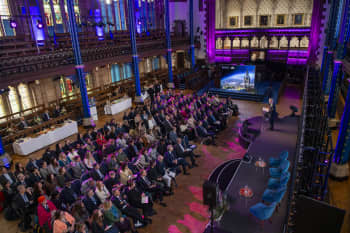
Andy Schofield, principal and vice-chancellor, U. of Glasgow, delivered his opening remarks in the university’s historic Bute Hall.
Andy Schofield, principal and vice-chancellor, U. of Glasgow, delivered his opening remarks in the university’s historic Bute Hall.
Developing Leaders of the Future
How can higher ed empower students today and prepare them for tomorrow?
Panelists in this session, “Developing Leaders of the Future: Resilience and Purpose in a Changing World,” offered a variety of suggestions, most of which converged on the importance of instilling flexibility. The recommendations included teaching students about “being comfortable with change,” “being able to make change,” fostering “calibrated wisdom” — the ability to stick to what you know, but be open to a constantly evolving world and adjust your knowledge accordingly — and developing resilience.
“We have to celebrate the failure that’s inherent in what we do,” said John McGhee, executive director of education for the Glasgow City Council. “Many inventors will tell you that it took them tens of thousands of attempts before they got to a solution. … We have to create environments where that skill is developed, and I’m not sure we’re absolutely great at it. The evidence would suggest we’re not.”

Participants at the U21 Leadership Summit held at the U. of Glasgow.
Participants at the U21 Leadership Summit held at the U. of Glasgow.
Knowledge, Skills, and Access
A central challenge universities are grappling with is the tension over providing academic rigor and depth of subject-matter knowledge versus workplace skills. Moira Fischbacher-Smith, vice principal for learning and teaching at the University of Glasgow, described the Scottish university structure as having the first two years devoted to study across a range of disciplines, giving students “breadth and a basis from which they can then specialize.” Yet, she noted, there is debate around how much specialization is actually helpful for students, given that the job market is shifting so rapidly. As a result, she said, the university is trying to integrate experiential learning in all of its programs.
The goal, according to Fischbacher-Smith, is not to separate out skills from academic learning, but rather to embed them in academic courses. “We have to help [students] surface that,” she explained, adding that “that would be important anyway, but so many of our students have caring responsibilities — so many other things going on in their lives — that if we don’t design all that into their degree program,” and rely on extracurricular activities, “we will exclude some students from learning opportunities that are absolutely critical for their future.”
“I meet a lot of people who don’t actually get to access opportunities where they can hone their skills,” said Sai Shraddha S. Viswanathan, president of the National Union of Students Scotland. Given the range of students from different backgrounds, financial circumstances, ethnicities, and nationalities in college, social, financial, and logistical barriers to opportunities remain. “When we think of skills, we often miss the accessibility part,” she said. Financial constraints mean, she added, that “a lot of students are living in survival mode.”
Participants at the U21 Leadership Summit held at the U. of Glasgow.
Participants at the U21 Leadership Summit held at the U. of Glasgow.
Knowledge, Skills, and Access
A central challenge universities are grappling with is the tension over providing academic rigor and depth of subject-matter knowledge versus workplace skills. Moira Fischbacher-Smith, vice principal for learning and teaching at the University of Glasgow, described the Scottish university structure as having the first two years devoted to study across a range of disciplines, giving students “breadth and a basis from which they can then specialize.” Yet, she noted, there is debate around how much specialization is actually helpful for students, given that the job market is shifting so rapidly. As a result, she said, the university is trying to integrate experiential learning in all of its programs.
The goal, according to Fischbacher-Smith, is not to separate out skills from academic learning, but rather to embed them in academic courses. “We have to help [students] surface that,” she explained, adding that “that would be important anyway, but so many of our students have caring responsibilities — so many other things going on in their lives — that if we don’t design all that into their degree program,” and rely on extracurricular activities, “we will exclude some students from learning opportunities that are absolutely critical for their future.”
“I meet a lot of people who don’t actually get to access opportunities where they can hone their skills,” said Sai Shraddha S. Viswanathan, president of the National Union of Students Scotland. Given the range of students from different backgrounds, financial circumstances, ethnicities, and nationalities in college, social, financial, and logistical barriers to opportunities remain. “When we think of skills, we often miss the accessibility part,” she said. Financial constraints mean, she added, that “a lot of students are living in survival mode.”

The Double-Edged Sword of Technology
Accessibility issues are intertwined with issues around technology. Institutions must expose their students to the latest tools and prepare them for a tech-infused world, but with that responsibility comes a risk. “Not all of our students turn up here with a laptop or an iPad,” said Fischbacher-Smith. “Poverty is real at university for students.” Glasgow has been working hard to embed accessibility tools in its virtual-learning environment, she said, because “it’s important that we embrace technology,” but cautioned that “we cannot do it in a way that inadvertently excludes students.”
As artificial intelligence reshapes every aspect of learning, universities are having to rethink the value of what they offer students and how to best prepare them for an AI-driven future. If people can teach themselves anything online without a human, asked Jenni Robertson, an education strategic adviser for Apple, what will they need a university for? In five years, or 20 years, will universities still be there?
“Of course,” said Sari Lindblom, rector of the University of Helsinki. “We are the ones who can find new solutions, new data, new innovations to solve future problems. We are also the places that provide our students with skills to survive in the future.”
There will be significant changes, said Viswanathan, but one thing that artificial intelligence can’t replicate or replace is human interaction. Higher-ed institutions “provide spaces, and are hubs, for building relationships.”
Universities offer something technology cannot. “We’re not creative if we don’t slow down, think about things, test our understanding, interact with people, and be challenged,” argued Fischbacher-Smith. “If we just outsource all of that to technology, we’ll be a poorer world for that.”
She added that universities are places for students to develop a sense of agency and identity, where they can learn through challenge, through meeting people they wouldn’t otherwise meet, and be confronted by a mix of disciplines and knowledge. “Where else can you get all that and discover things you didn’t know you had an interest in?”
The Double-Edged Sword of Technology
Accessibility issues are intertwined with issues around technology. Institutions must expose their students to the latest tools and prepare them for a tech-infused world, but with that responsibility comes a risk. “Not all of our students turn up here with a laptop or an iPad,” said Fischbacher-Smith. “Poverty is real at university for students.” Glasgow has been working hard to embed accessibility tools in its virtual-learning environment, she said, because “it’s important that we embrace technology,” but cautioned that “we cannot do it in a way that inadvertently excludes students.”
As artificial intelligence reshapes every aspect of learning, universities are having to rethink the value of what they offer students and how to best prepare them for an AI-driven future. If people can teach themselves anything online without a human, asked Jenni Robertson, an education strategic adviser for Apple, what will they need a university for? In five years, or 20 years, will universities still be there?
“Of course,” said Sari Lindblom, rector of the University of Helsinki. “We are the ones who can find new solutions, new data, new innovations to solve future problems. We are also the places that provide our students with skills to survive in the future.”
There will be significant changes, said Viswanathan, but one thing that artificial intelligence can’t replicate or replace is human interaction. Higher-ed institutions “provide spaces, and are hubs, for building relationships.”
Universities offer something technology cannot. “We’re not creative if we don’t slow down, think about things, test our understanding, interact with people, and be challenged,” argued Fischbacher-Smith. “If we just outsource all of that to technology, we’ll be a poorer world for that.”
She added that universities are places for students to develop a sense of agency and identity, where they can learn through challenge, through meeting people they wouldn’t otherwise meet, and be confronted by a mix of disciplines and knowledge. “Where else can you get all that and discover things you didn’t know you had an interest in?”
This Key Takeaways was produced by Chronicle Intelligence. Please contact CI@chronicle.com with questions or comments.
©2026 by The Chronicle of Higher Education Inc. All rights reserved. This material may not be reproduced without prior written permission of The Chronicle. For permission requests, contact us at copyright@chronicle.com.
 Built with Shorthand