



Proximity Is Key
Where Industry and Academia Share a ZIP Code


Northwest Arkansas boasts one of the most advanced supply chain ecosystems geographically in the world. It makes sense, given it is home to Walmart, J.B. Hunt, Tyson Foods, Simmons Foods, Uber Freight and other Fortune 100 companies. The Northwest Arkansas area is a hub for industry partners who are on the cutting edge of supply chain management.
It also makes sense, then, that the J.B. Hunt Transport Department of Supply Chain Management within the Sam M. Walton College of Business at the University of Arkansas is nationally recognized in its field. Gartner ranks the college’s undergraduate supply chain program as the best in North America (2024), and The SCM Journal List ranks the department 5th in the world for empirical supply chain research (2025).
Marc Scott, associate professor of practice and associate department chair, believes the university’s proximity to this unique supply chain ecosystem is what sets it apart – both in terms of research conducted and the students who graduate.
“Industry-connected, industry-engaged: We’re the best at it,” he says. “There is a density of supply chain expertise, and we have the university sitting right in the middle of it. That is leveraged to produce massive benefits to our research and teaching. Our supply chain ecosystem differentiates us and gives us the competitive advantage of being very industry-forward.”


INDUSTRY AND ACADEMIA
Scott is a logistician by training and holds a doctoral degree in transportation and logistics. He also has experience working in industry, which he says significantly informs the way he approaches academia.
Scott credits the leadership of the Walton College with a comprehensive view of what impact can be provided by academia. He believes the college uses research to drive rigorous academics and takes an industry-forward approach to inform the research being conducted by the school and classroom instruction.
“There is an emphasis on that research being pragmatic as well, having pragmatic implications and being brought to classes,” he says. “Students, doctoral students and professors work closely with industry to understand problems and study those problems to produce academically rigorous research while simultaneously generating insights that are practical and actionable for industry players.”

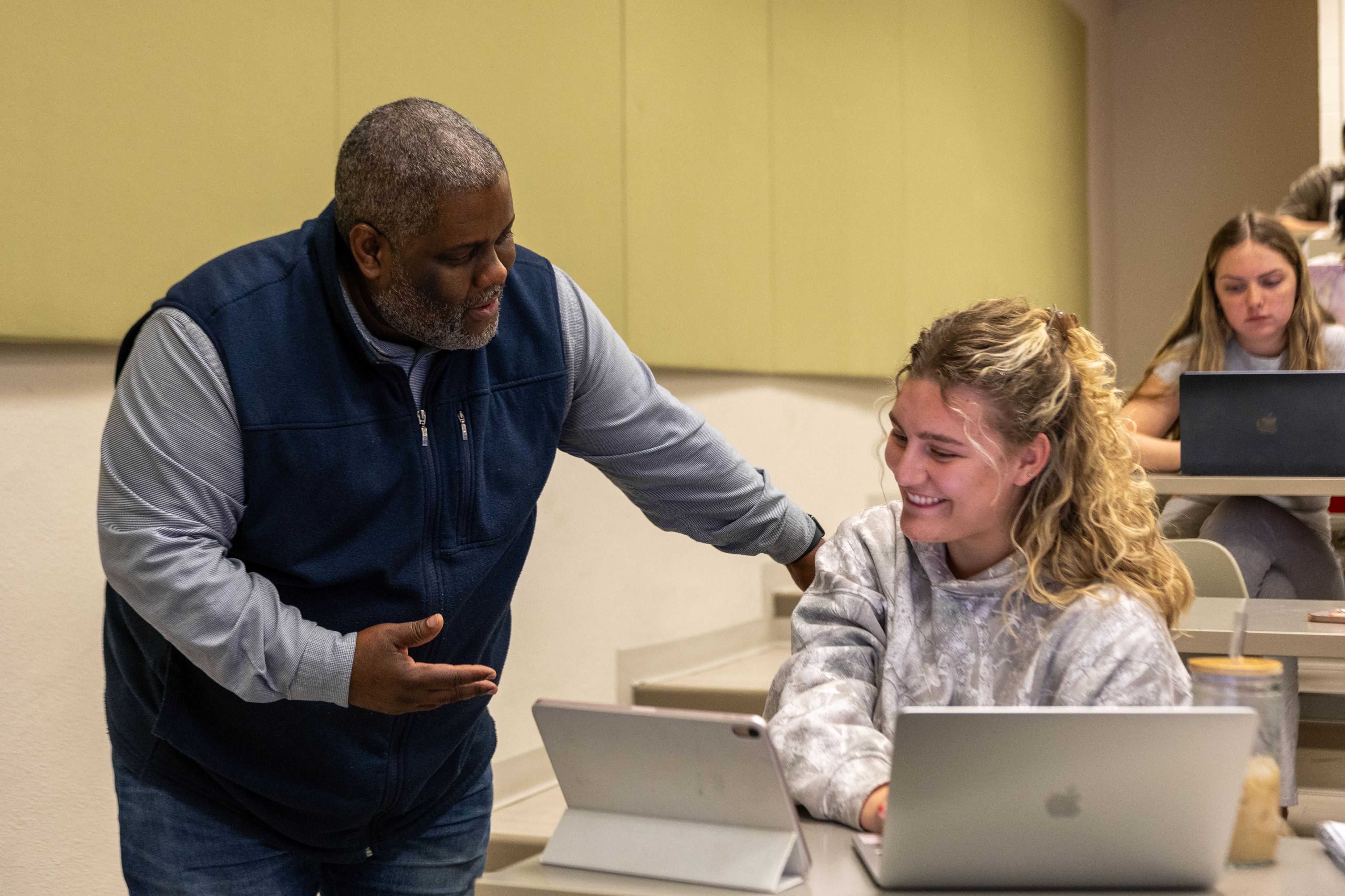
Marc Scott works with a student in a Walton College class.
Marc Scott works with a student in a Walton College class.
The Walton College accomplishes this thanks to a “unique blend” of faculty, which includes research-oriented professors, teaching-oriented professors, practice and outreach-oriented professors and instructors and lecturers with industry experience. This ensures that industry informs the curriculum and has a place in the classroom.
That classroom experience is where students gain the tools needed for them to succeed in the workplace after graduation.
“Real-world experience helps them connect what they learn in the class but also sets them apart when they interview and enter the job market,” Scott notes.
Students majoring in supply chain interact with industry experts through panel discussions, courses and workshops designed to engage students in applied learning. In the classroom, they’re given case studies and live projects where they work in tandem with industry partners for mentorship and problem-solving guidance. According to Scott, this results in students who graduate from the university as adaptable, market-relevant employees.
One notable facet of the supply chain degree program is the requirement for supply chain majors to take on an internship. The program invests three credit hours in each student’s future by requiring this real-world experience.
Scott is a logistician by training and holds a doctoral degree in transportation and logistics. He also has experience working in industry, which he says significantly informs the way he approaches academia.
Scott credits the leadership of the Walton College with a comprehensive view of what impact can be provided by academia. He believes the college uses research to drive rigorous academics and takes an industry-forward approach to inform the research being conducted by the school and classroom instruction.
“There is an emphasis on that research being pragmatic as well, having pragmatic implications and being brought to classes,” he says. “Students, doctoral students and professors work closely with industry to understand problems and study those problems to produce academically rigorous research while simultaneously generating insights that are practical and actionable for industry players.”
Marc Scott works with a student in a Walton College class.
Marc Scott works with a student in a Walton College class.
The Walton College accomplishes this thanks to a “unique blend” of faculty, which includes research-oriented professors, teaching-oriented professors, practice and outreach-oriented professors and instructors and lecturers with industry experience. This ensures that industry informs the curriculum and has a place in the classroom.
That classroom experience is where students gain the tools needed for them to succeed in the workplace after graduation.
“Real-world experience helps them connect what they learn in the class but also sets them apart when they interview and enter the job market,” Scott notes.
Students majoring in supply chain interact with industry experts through panel discussions, courses and workshops designed to engage students in applied learning. In the classroom, they’re given case studies and live projects where they work in tandem with industry partners for mentorship and problem-solving guidance. According to Scott, this results in students who graduate from the university as adaptable, market-relevant employees.
One notable facet of the supply chain degree program is the requirement for supply chain majors to take on an internship. The program invests three credit hours in each student’s future by requiring this real-world experience.
RELEVANT RESEARCH
Industry partners benefit from market-ready graduates, but they benefit from the university’s research expertise as well.
Research done by the Walton College provides value to industry, and industry’s complex situations provide an excellent case study for researchers (and students). It’s a relationship where all parties win – the faculty are given real-world challenges to address, industry partners are provided with results and potential solutions, and students are involved throughout the process.
“Because of our proximity, we tend to engage with companies or have interaction with companies that are studying or addressing the most advanced supply chain challenges and using some of the most advanced supply chain approaches,” Scott explains. “The research we do in partnership with these companies or with the knowledge of what they are doing provides best practice insights for almost everybody in the industry. We’re learning and researching alongside the best of the best, particularly in logistics, fulfillment operations and retail supply chain management.”
The Supply Chain Management Research Center contributes applied research to industry and fosters the ongoing relationship between industry experts and the college. Their work provides direct insights to companies, through white papers, podcasts, panels at industry-based conferences and workshops.
Beyond industry, the department is working to support our national security. The challenges and solutions developed through Northwest Arkansas’ supply chain expertise can often be applied to military operations and defense logistics.
A specific field of application that continues to develop is contested logistics, which is often used by the defense and aerospace fields to address the movement, supply and repair of forces that could be actively targeted, disrupted or delayed by adversaries.
“As a department, and as a college, we are providing insights and expertise to help these players better understand supply chain best practices,” Scott explains.






This content was paid for and created by the University of Arkansas. The editorial staff of The Chronicle had no role in its preparation. Find out more about paid content.
 Built with Shorthand