


InSPIRing Growth
Stony Brook University program delivers career boost to more than 3,000 students while fueling local startup growth
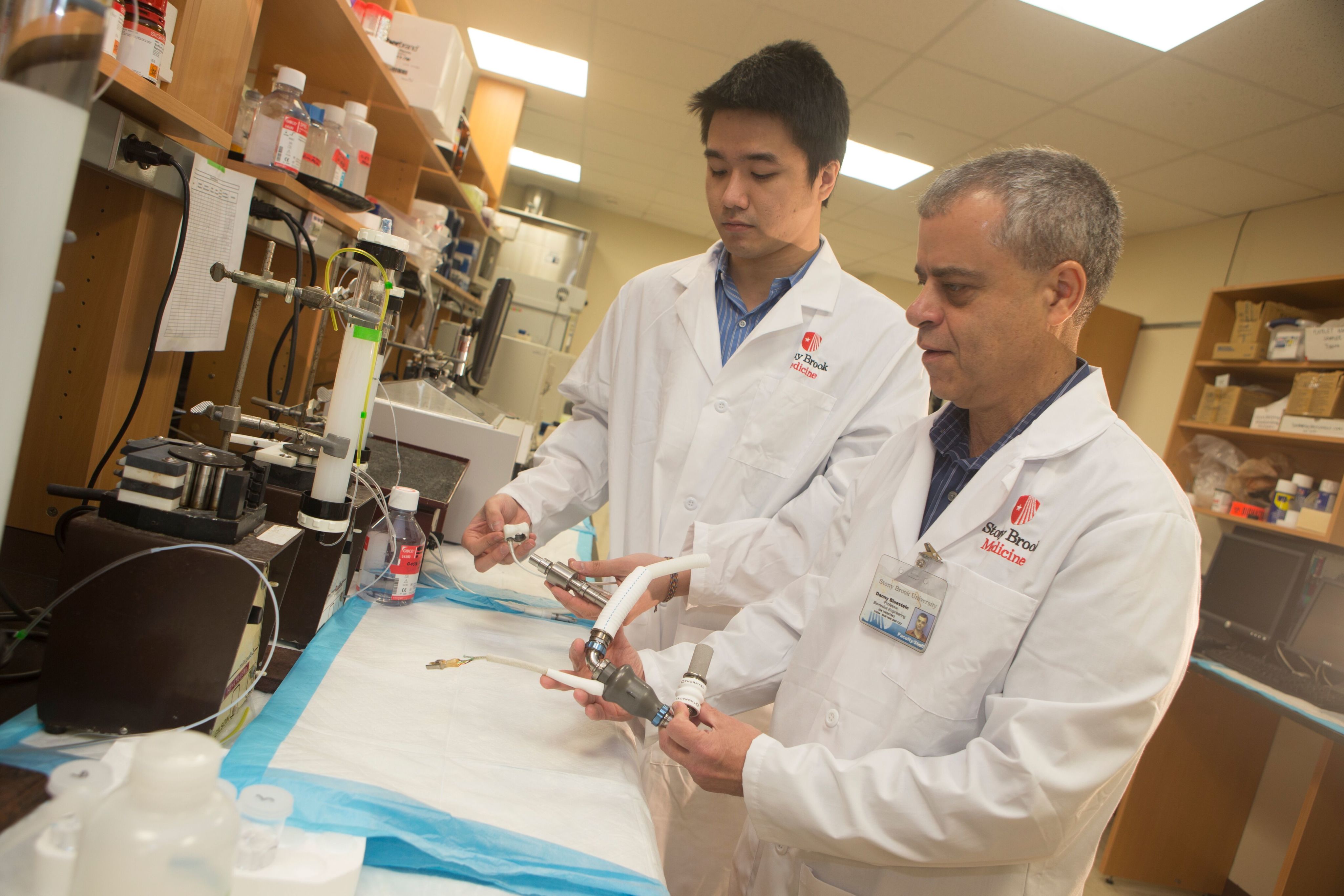

Danny Bluestein, SUNY Distinguished Professor in the Department of Biomedical Engineering (right), is also the principal investigator at PolyNova Cardiovascular Inc., which is developing prosthetic heart valves. Through the company's partnership with SPIR, students can work on projects “directly related to their PhD dissertation.”
Alexander Sokolov, BS/MS ’21 was an undergraduate student dual majoring in computer engineering and computer science at the State University of New York at Stony Brook University (SBU) while he was also gaining critical professional engineering experience. He wrote code, looked at schematics and worked closely with the electrical team at Intelligent Product Solutions (IPS), where he was interning. The local product-design company, which provides solutions to companies like Google and Verizon, then hired Sokolov full-time while he was still earning his master’s in engineering at the university.
What made it possible for Sokolov to avoid the frustration of employers requiring hands-on work experience before considering hiring someone postgraduation is the Strategic Partnership for Industrial Resurgence (SPIR) at Stony Brook’s Office for Research and Innovation. Since 1994, SPIR has made that connection possible for more than 3,000 College of Engineering and Applied Sciences (CEAS) students, enabling them to add substantial expertise to their résumés before graduation, according to Director Lisa Chichura, PhD.
That’s because SPIR helps companies solve engineering and technical problems using State University of New York (SUNY) resources, including undergraduate and graduate students, postdocs, faculty, laboratories and specialized facilities. Chichura said that SBU was the lead institution in getting funding from SUNY, but other SPIR programs are located at the University at Albany, Binghamton University and University at Buffalo. Since its start, SBU SPIR has helped companies in New York create and retain jobs, with a total of 17,614 combined statewide as of 2024.
“The SPIR program at Stony Brook provides critical resources for training because we help students who are coming from a purely academic place where they may have limited lab experience,” she said. “With SPIR, they have the opportunity to work on a real-world project with a company. It’s really valuable for our students to be able to have that experience.”
In fact, over the past 31 years, Stony Brook’s SPIR program, which is located at the university’s Center of Excellence in Wireless and Information Technology (CEWIT), has completed more than 4,000 projects with more than 610 companies, Chichura said. Her office has done so with the help of roughly 80 to 100 undergraduate and graduate students a year, from CEAS departments including Applied Mathematics and Statistics, Materials Science, Electrical Engineering, Mechanical Engineering, Biomedical Engineering and Computer Science.


Alexander Sokolov, BS/MS ’21 is one of the many former SPIR students that Lisa Chichura stays in contact with. “I enjoy coming back to Stony Brook because it gives me the opportunity to give students information about what they might experience as engineers after they graduate.”
Alexander Sokolov, BS/MS ’21 is one of the many former SPIR students that Lisa Chichura stays in contact with. “I enjoy coming back to Stony Brook because it gives me the opportunity to give students information about what they might experience as engineers after they graduate.”
“Usually employers seek people who already have industrial experience. But if you don’t get the experience while you’re a student, how will you get the job? The SPIR program is a huge relief to my students because they can do the internship during the school year, getting both a salary and tuition assistance. Then the student has a much better chance to find a job because they’re now graduating with experience.”


At the helm of SPIR, Lisa Chichura drives collaborations that give Stony Brook students vital, real-world experience while fueling workforce growth across Long Island.
At the helm of SPIR, Lisa Chichura drives collaborations that give Stony Brook students vital, real-world experience while fueling workforce growth across Long Island.
Retaining Local Talent
In the high-tech, competitive marketplace SPIR’s experiential learning mission also contributes significantly to innovation and economic development in the state, Chichura said, helping companies bring in $3.15 million (2025) to the region through funding sources like the Small Business Administration’s SBIR/STTR program and the New York State Energy Research and Development Authority.
“Generally, we fill a gap where the company may have a project that is not big enough to hire a person with a specific background, but we can provide a graduate or an undergraduate student to help them complete that project,” she said. “Grad students receive a stipend and graduate tuition scholarships are provided to support students in engineering disciplines.”
Chichura said the program sponsors industry projects through cost-sharing arrangements across a wide range of scientific and engineering disciplines, providing services including research and development, new product development, testing and evaluation and quality assurance.
That all has an impact on the region by connecting Stony Brook students like Sokolov with Long Island-based companies — from industries including aerospace and defense, medical and software companies, to name a few — in mutually beneficial internships. Chichura said for the most recent completed fiscal year, SPIR supported 90 projects over the academic year working with 49 companies — 14 of which were new to the SPIR program. SPIR also created an estimated additional 251 jobs through projects involving 82 students and 23 faculty, she said.

Business Incubators
While the SPIR program provides matching funds to support projects with New York state companies, SPIR is particularly focused on startup companies in SBU’s incubator facilities and commercialization of Stony Brook technologies.
These include incubators in the Long Island High Technology Incubator (LIHTI), a nonprofit organization adjacent to the hospital dedicated to helping new technologically innovative companies grow, where there are currently 22 companies (including PolyNova Cardiovascular); a designated incubator space in the CEWIT, where there are 14 companies; and another six in the Advanced Energy Research and Technology Center (AERTC).
Chichura added that SPIR also works with professors who start companies and who hold patents “because it focuses on supporting the incubator companies and on supporting Stony Brook technology, helping to move the technology into the marketplace.”
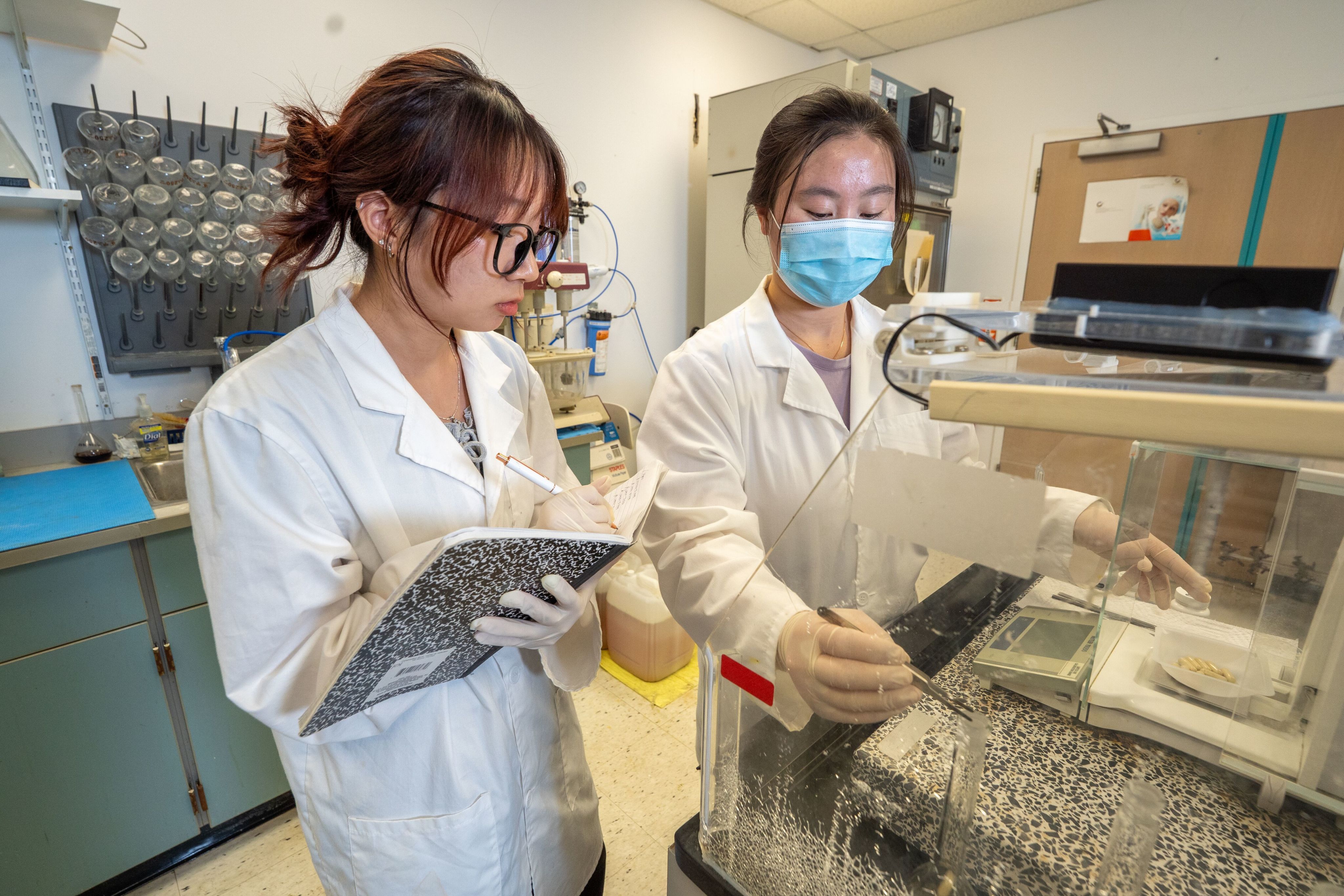
One of the startups is Chroma Labs, which CEO Jenitta Jolly has been running out of LIHTI since 2021. Jolly said her private, for profit company specializes in testing vitamin supplements for contaminants like microbiological organisms. In 2024, Jolly said she wanted to hire student interns from the university so that she could get help in her lab while also giving students related experience. She worked with SPIR to help select the candidates and make recommendations for interviews.
Jolly said she believes that without her two SBU interns, she wouldn’t have been able to achieve important business goals. “And my interns got to work with sensitive and expensive equipment they wouldn’t have been able to at a bigger company. They’re undergrads who already have graduate-level experience with all the lab facilities doing microbiology testing and testing for harmful substances like arsenic in supplements.”
Intern Tina Hong, a senior health science major who expects to graduate in May 2026, began working for Jolly in March 2024 as a sophomore. “It’s really difficult to get lab experience as a student since you have no certifications and most places don’t like getting undergrad students,” Hong said. “Here, I’ve been able to connect the dots between my microbiology class and my lab experience. Being able to work in the lab gives me exposure to research and that expert experience can lead to further progress in the future when I apply to jobs.”
Jing Wei Liu agreed. She’s also a senior health science major who expects to graduate in May 2026 and has been working with Jolly since September 2024. “I value the hands-on lab experience, including microbiome testing and chemical analysis for heavy metals and getting to follow all the safety procedures,” Liu said. “And I was able to get it starting as a junior. It’s a great start for me because I’ve been able to gain hands-on experience in the lab, which gives me an advantage.”

This content was paid for and created by Stony Brook University. The editorial staff of The Chronicle had no role in its preparation. Find out more about paid content.
 Built with Shorthand