



How Academia is Contributing to Curbing Gun Violence

Most of us have heard the statistics: More than 1 million people have been shot over the course of the past decade in the United States, and gun violence rates are rising across the country. In 2021, the most recent year for which complete data is readily available, almost 50,000 people died from gun-related injuries.

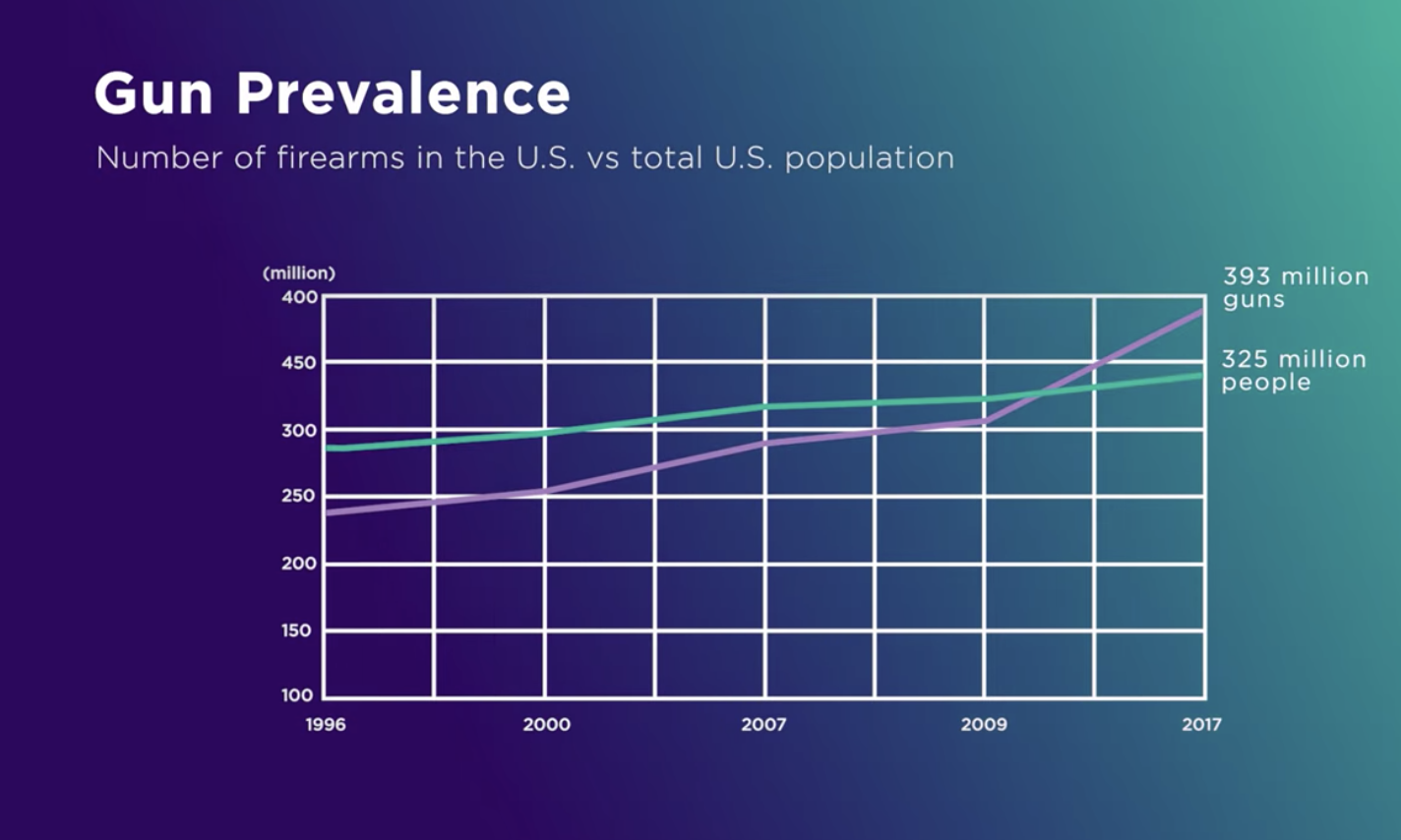
The number of guns in the United States surpassed the population around 2009, according to data from the Congressional Research Service and ATF and highlighted during an Engineering Safer Cities event hosted by the Center for Urban Science + Progress at NYU Tandon.
The number of guns in the United States surpassed the population around 2009, according to data from the Congressional Research Service and ATF and highlighted during an Engineering Safer Cities event hosted by the Center for Urban Science + Progress at NYU Tandon.
Finding effective ways to stem the violence depends, in part, on data about the complex set of factors that influence attitudes on guns, gun ownership and violent incidents, as well as the impact various policies have. But for nearly a quarter-century years after the passage of the Dickey Amendment, which prevented the Centers for Disease Control from using its funding "to advocate or promote gun control," researchers were unable to access critical funding to study gun violence. This moratorium severely constrained federal funding for all firearm research, slowing down scientific advancements in the field and robbing citizens and legislators alike of the opportunity to gain a data-driven understanding of the firearms ecosystem, and the subsequent ability to craft effective evidence-based policies.
A Researcher Steps into the Void
In 2020, two years after a large Congressional spending bill passed with a compromise on gun violence research, Maurizio Porfiri became one of the first and few academic gun-violence researchers funded by the U.S. government. Porfiri, an Institute Professor at the NYU Tandon School of Engineering and director of the school’s Center for Urban Science and Progress, and an expert in the study and modeling of complex systems, won a $2 million grant from the National Science Foundation to investigate what he terms the “firearm ecosystem” – an intricate interplay involving individual behavior, state-level policies, and national dynamics.
Porfiri was moved to study the issue through personal experience: he had just moved to New York City to start his career as an engineering professor at NYU Tandon in 2007 when a mass shooting at Virginia Tech – where he had earned his PhD the prior year – claimed the lives of 32 people. The victims included some of his close colleagues and mentors.
The tragedy galvanized Porfiri’s determination to help find solutions to mitigate the devastating effects of gun violence. As he continued acquiring new data science skills in the subsequent years, Porfiri became convinced that research like his could provide solid scientific evidence to inform effective public policies.

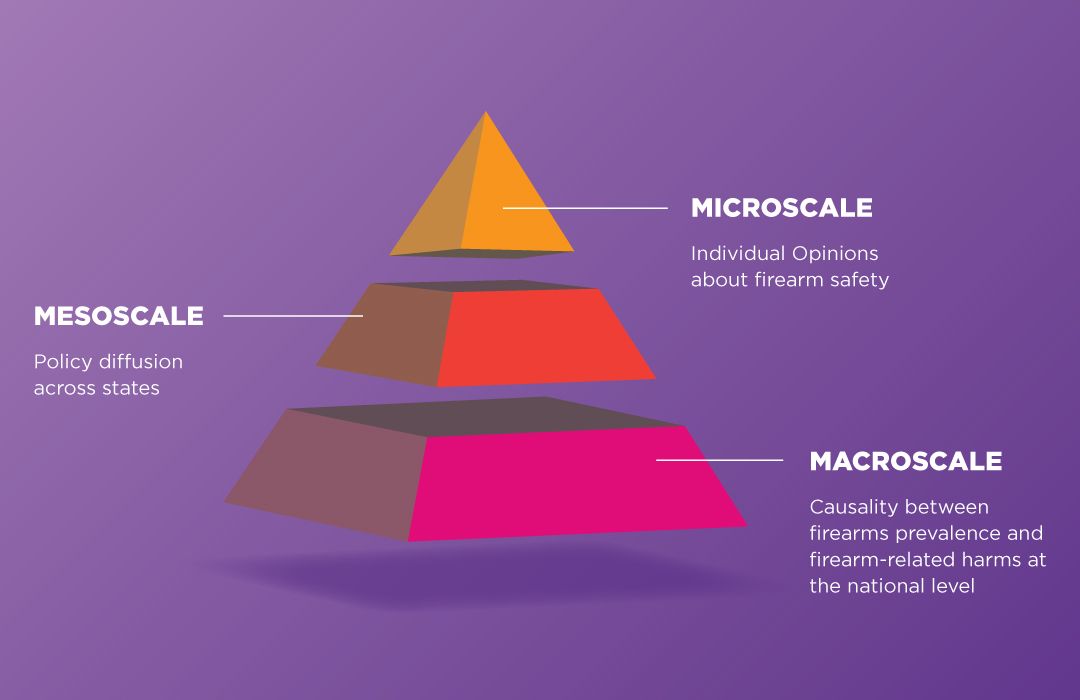
Porfiri and his research collaborators are working to harness and analyze data about firearms simultaneously on three levels – the microscale, including individual opinions on firearms; the mesoscale, such as policy diffusion across states; and the macroscale, including causality between firearm prevalence and firearm-related harms at the national level.
Porfiri and his research collaborators are working to harness and analyze data about firearms simultaneously on three levels – the microscale, including individual opinions on firearms; the mesoscale, such as policy diffusion across states; and the macroscale, including causality between firearm prevalence and firearm-related harms at the national level.
Causation and correlation
Porfiri’s mathematical techniques uncover causal links between variables in the firearm ecosystem - media coverage, regulations, and policies, for example – not just correlations between these factors. He honed these techniques in his other research into collective behavior, including his studies examining how some fish “lead” their schools’ movements.
Porfiri’s findings often challenge conventional wisdom, suggesting new possible solutions. His team’s investigation into the correlation between mass shootings and firearm sales, for example, found that contrary to popular belief, fear or protective instincts did not significantly influence gun purchases after mass shootings. Instead, Porfiri's research team identified a strong causal link between media coverage of potential gun regulation and increased firearm sales. Individuals appeared to purchase guns in response to concerns about potential restrictions, sparked by media stories around regulatory measures. This insight lends weight to efforts to maintain a steady drumbeat of media discussion around gun regulation, rather than just when tragic events occur.



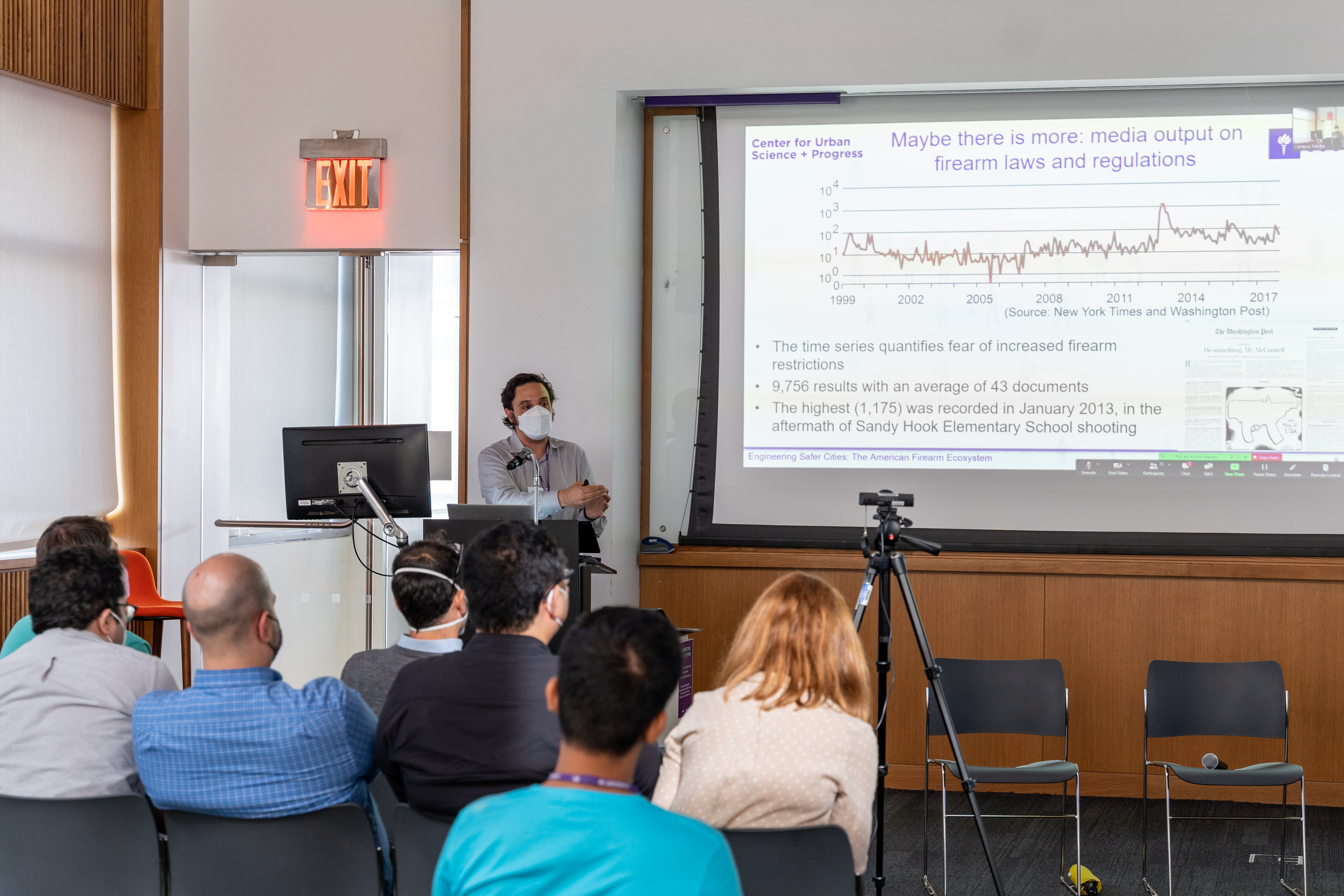
Porfiri discusses his findings about the relationships between media coverage and firearm laws, regulations, and gun ownership at the Engineering Safer Cities event in September 2022. Photo credit: Anna Sawulska.
Porfiri discusses his findings about the relationships between media coverage and firearm laws, regulations, and gun ownership at the Engineering Safer Cities event in September 2022. Photo credit: Anna Sawulska.
More recently, he discovered that fame-seeking mass shooters – as opposed to those motivated by personal grievance or revenge, for instance – attempted to draw outsized attention to themselves by deliberately choosing unique targets and locations for their crimes.
This finding upended common assumptions that fame seekers sought notoriety mainly by trying to maximize casualties. It could strengthen the case for robust "red flag” laws, so that people threatening mass violence could be legally disarmed, even if their threats seem outlandish based on historical precedent.


Porfiri and his team created a new data model that predicts monthly gun homicide rates more accurately than other techniques currently in use.
Porfiri and his team created a new data model that predicts monthly gun homicide rates more accurately than other techniques currently in use.
Filling the Data Gaps
Gun violence research often grapples with inadequate, inconsistent, and outdated official data on gun prevalence and violence rates, leaving policy makers without vital up-to-date and accurate information to make well-informed decisions
Porfiri and his research team develop sophisticated mathematical models to generate indirect measures of those rates, bridging glaring gaps. Recently, he combined data from the U.S. government, police departments, media outlets, and other sources to create a model that predicts monthly gun homicide rates – up to one year out – with better accuracy than techniques researchers typically use. The model also “backcasts” as recently as one month prior, a significant achievement considering the federal government’s official monthly gun death data can be nearly two years old when it is released.
Porfiri has also constructed a statistical model that predicts state-by-state gun possession and ownership rates, information lacking from any official government source. The model fuses data from two available proxies, background checks per capita and suicides committed with firearms in a given state, providing results more accurate than either proxy on its own.
That model is now being used to explore which policies are effective in reducing death by guns in a state and its surrounding regions, and how the relationship between gun ownership and violent outcomes is disrupted by various pieces of legislation.
What’s Next?
Porfiri’s future studies will trace how people purchase guns based on their locations, investigate peer pressure's role in gun acquisition, and interrogate causes of suicides by firearms. He and his team are also seeking to collaborate with city governments to develop methods for monitoring illegal firearms.
As he continues to navigate the confluence of engineering, mathematics, and gun violence research in America's "firearm ecosystem,” Porfiri is developing insights that challenge established norms, inform evidence-based policies, and pave the way towards a safer future.


This content was paid for and created by NYU Tandon. The editorial staff of The Chronicle had no role in its preparation. Find out more about paid content.
 Built with Shorthand