



Five Ways Thomas Jefferson University Research Is Improving Lives Around the World


Five Ways Thomas Jefferson University Research Is Improving Lives Around the World


Thomas Jefferson University is home to pioneering researchers, innovators, creators and problem-solvers. For more than two centuries, our faculty, students and investigators have driven discoveries across disciplines from medicine to advanced textiles, from design and architecture to biodiversity and sustainable development. And they’ve applied that new knowledge to improve the lives of people in all walks of life, in communities across the nation and around the world.
Jefferson is a research powerhouse with over 1,900 full-time faculty, including 464 externally funded principal investigators and scholars, supported by more than $200 million a year in funding from federal and state agencies, corporations, foundations and philanthropists. The University holds more than 1,000 patents for new drugs, innovative technologies and software, and advanced medical devices and diagnostic tools.
Our world-class scholars and investigators work across the research spectrum from bench science to clinical and applied studies — in fields ranging from biomedical and social sciences to arts and humanities, business and public policy. They are developing more effective ways of diagnosing and treating cancer, creating more sustainable industrial processes and building materials, driving new opportunities for equitable economic development, and reducing disparities in health care and public health.
We are redefining possible by striving to address problems once thought insurmountable.
Here are exciting examples of how Jefferson researchers are working to improve human health, protect our world’s natural systems and make life better in myriad ways.


Calorie-Cutting Enhances Cancer Treatment
Early in her career, radiation oncologist Nicole Simone, MD, found that restricting the calories ingested by lab mice could improve the effectiveness of radiation treatments for cancerous tumors. Those mice had smaller and fewer tumors and survived longer than mice on regular diets. “We concluded that tumor cells can’t deal with the stress of having radiation and calorie restriction at the same time,” Dr. Simone says. “Their cell machinery doesn’t work as well, so they die faster.”
That discovery spurred her to explore if calorie reduction could be safe and effective for her patients undergoing radiation treatment for breast cancer. Her studies found that it was possible — and even empowering — for cancer patients to eat a calorie-restricted diet under medical supervision. She is now leading a clinical trial with patients to determine if a 25% calorie reduction can enhance the tumor-shrinking effects of radiation administered before surgery. Dr. Simone anticipates enrolling 90 breast cancer patients in the trial and reporting results in about two years. But initial results have made her optimistic: “So far, all patients have seen decreased tumor size, and some had evidence of their breast cancer disappearing entirely.”
Calorie-Cutting Enhances Cancer Treatment
Early in her career, radiation oncologist Nicole Simone, MD, found that restricting the calories ingested by lab mice could improve the effectiveness of radiation treatments for cancerous tumors. Those mice had smaller and fewer tumors and survived longer than mice on regular diets. “We concluded that tumor cells can’t deal with the stress of having radiation and calorie restriction at the same time,” Dr. Simone says. “Their cell machinery doesn’t work as well, so they die faster.”
That discovery spurred her to explore if calorie reduction could be safe and effective for her patients undergoing radiation treatment for breast cancer. Her studies found that it was possible — and even empowering — for cancer patients to eat a calorie-restricted diet under medical supervision. She is now leading a clinical trial with patients to determine if a 25% calorie reduction can enhance the tumor-shrinking effects of radiation administered before surgery. Dr. Simone anticipates enrolling 90 breast cancer patients in the trial and reporting results in about two years. But initial results have made her optimistic: “So far, all patients have seen decreased tumor size, and some had evidence of their breast cancer disappearing entirely.”
Making Waste Productive
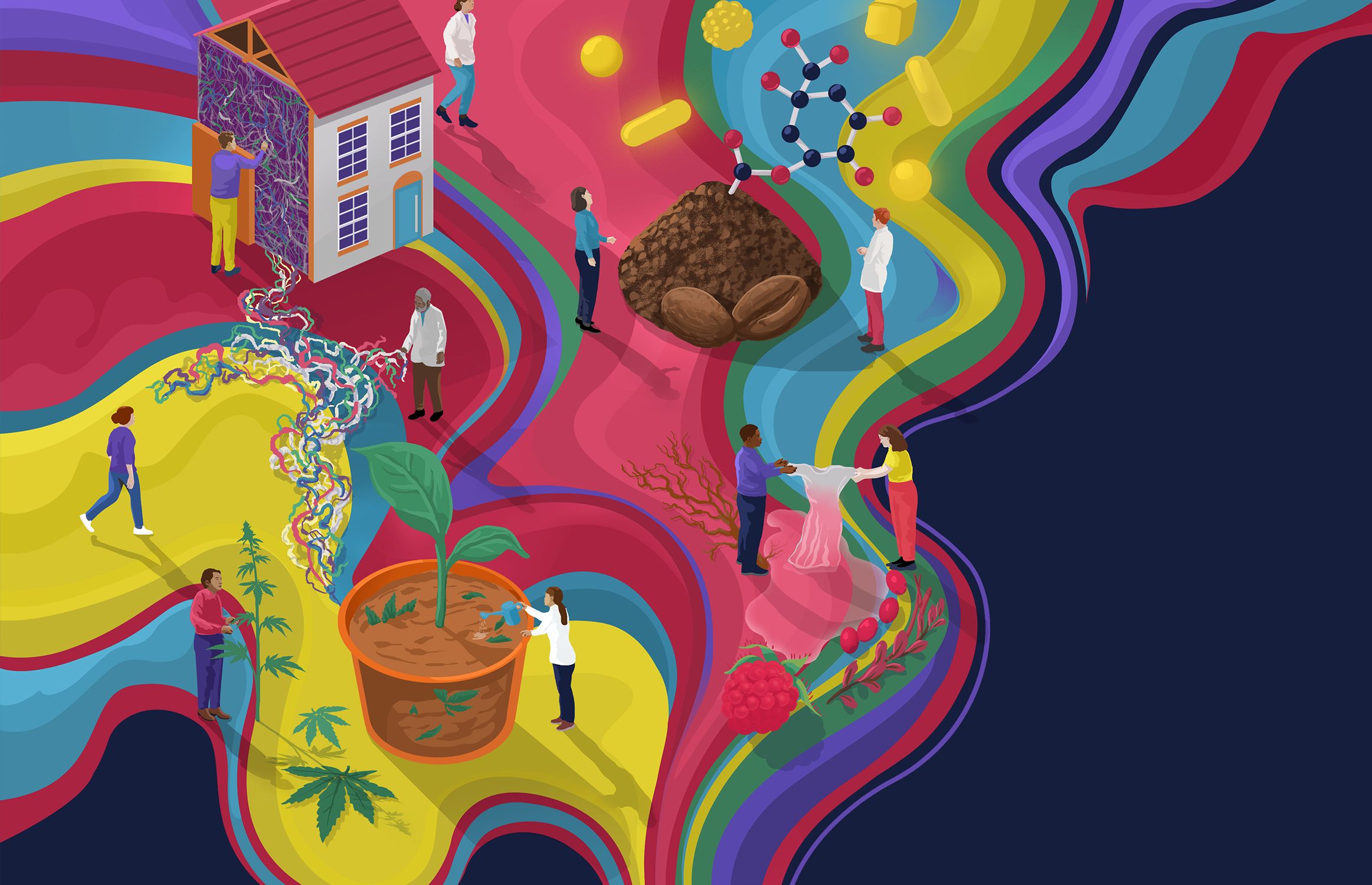
The world creates about two billion tons of municipal solid waste every year — an amount projected to grow 50% by mid-century. Solving the “waste problem” isn’t just a matter of determining where to dump more trash; it also requires reducing the natural resources used for replacement products, and using fewer toxic chemicals and pollutants to produce them. That’s why Jefferson researchers are developing innovative ways to reuse waste materials.
Chemist Niny Z. Rao, PhD, and physicist Brian Yust, PhD, are using waste materials like coffee as substitutes for toxic and expensive chemical catalysts. “Spent coffee grounds have great potential in green chemistry,” Dr. Rao explains, “because they contain bountiful amounts of antioxidants and other naturally occurring chemicals.” She and Dr. Yust have shown that spent grounds can be used to create gold and silver nanoparticles — which have unique properties that are essential for products ranging from food packaging to medical imaging. “Today, nanoparticles synthesis uses hazardous chemicals and creates toxic by-products,” Dr. Yust says. “But we’ve found that just two grams of spent grounds can be used to create varied nanoparticle shapes and sizes without corrosive chemicals. And we’re identifying other ways to make highly productive use of spent coffee grounds.”
“Waste wool” is left over from the million-plus tons of wool used in consumer and industrial products each year. It’s estimated that hundreds-of-thousand tons of it go to landfills each year. Jefferson engineering researchers Brian George, PhD, and Ryan Masoodi, PhD, are working to turn wool waste into commercially viable products. “The methods we’re developing could be applied to many kinds of textile wastes and used for an array of products,” Dr. George explains. He and Dr. Masoodi are especially pleased about their project’s potential to spark new businesses and jobs: They’ve been collaborating with local companies to test specific commercial uses of fabric types being developed. However, all of the products they’ll develop will be designed for long-term use, so they don’t quickly show up in waste dumps.

Rewiring Rabies
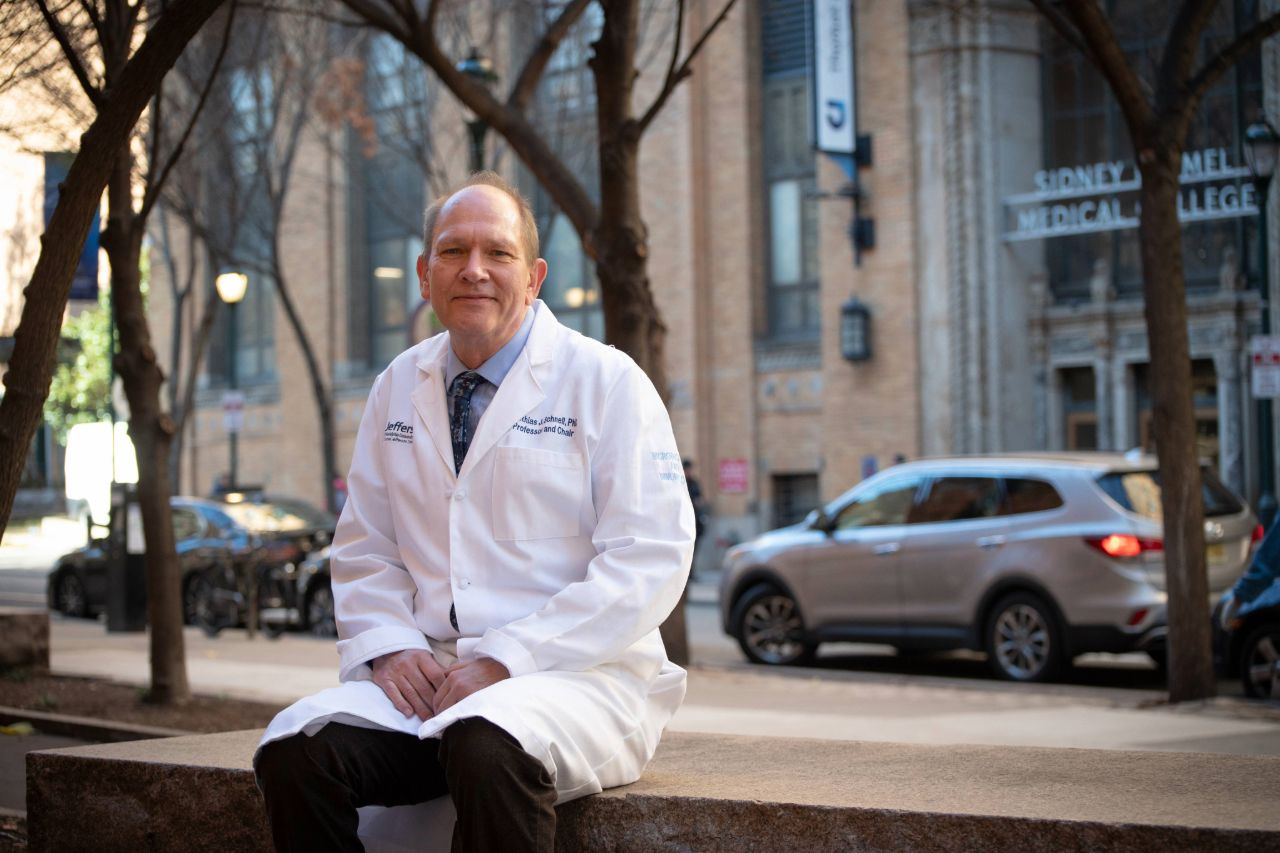
Jefferson vaccine researcher Matthias Schnell, PhD, has long studied the often lethal rabies virus; his discoveries have led to more effective vaccines for both humans and animals. Not content with countering the rabies virus, he’s used it to create vaccines for many other life-threatening conditions, including major threats such as Ebola and Marburg diseases. A current Lassa fever vaccine now in initial clinical trials uses a modified rabies virus to train the immune system to fight both Lassa and rabies. Another vaccine in development aims to protect cattle against the H5N1 avian flu and help prevent its transmission from cows to humans.

Rewiring Rabies
Jefferson vaccine researcher Matthias Schnell, PhD, has long studied the often lethal rabies virus; his discoveries have led to more effective vaccines for both humans and animals. Not content with countering the rabies virus, he’s used it to create vaccines for many other life-threatening conditions, including major threats such as Ebola and Marburg diseases. A current Lassa fever vaccine now in initial clinical trials uses a modified rabies virus to train the immune system to fight both Lassa and rabies. Another vaccine in development aims to protect cattle against the H5N1 avian flu and help prevent its transmission from cows to humans.
Seeing Sounds of Nature
Jefferson visual communication and information designer Renee Walker, MFA, studies how to present information in emotionally engaging and easily understandable ways. But she worries about the demands on our visual energy made by our extensive interactions with screens. Her research is focusing on how the next generation of designers might create digital experiences that are more multisensory, incorporating sound, vision and touch. “Designing for a range of sensory experiences could allow people to tap into senses they might overlook and deepen their awareness of our surroundings and nature,” she explains.
To test that idea, Walker and two of her students created a multifaceted digital technology that translates bird song into varied sensory inputs presenting information such as the bird’s color, physical description and type. Now, she’s expanding her work to explore multisensory ways of receiving information such as weather updates and forecasts. “Ultimately, I hope this work shows that sensory data used in digital design and tools can better connect us to each other and our surroundings,” she explains.




This content was paid for and created by Thomas Jefferson University. The editorial staff of The Chronicle had no role in its preparation. Find out more about paid content.
 Built with Shorthand