


As Colleges Face More Uncertainty Than Ever
Mergers and Partnerships Offer a Path Forward


For schools to survive the seismic shifts in student demographics, learning modalities, falling revenue and other monetary support, they have to think and act differently. Even prior to COVID-19, some schools were seeing enrollment declines; now schools will have to further revisit their plans to thrive in the future.


[WRAP-LEFT]
[WRAP-LEFT]
“Ultimately there are thousands upon thousands of universities, and there are frankly not enough students to go around to meet the enrollment needs of all of them,” states Scott Friedman, Strategy & Analytics principal at Deloitte Consulting. “Rather than running the risk of an institution being forced to close and not being able to effectuate their mission, I think it's a better option for schools to start to find partners where they have the capability to engage their mission in some way, even if not the way that they originally planned,” he contends.


[WRAP-LEFT]
[WRAP-LEFT]
Thought leaders in academia agree that such arrangements are pragmatic. “I think it is wise for leaders of all types and sizes of institutions to have the possibility of mergers and partnerships in their playbook. These partnerships should be one option among many for institutions to consider for building or maintaining fiscal strength as well as market position and curricular vitality,” says NACUBO President and CEO Susan Whealler Johnston, Ph.D.
The number of colleges and universities partnering or merging was on the increase prior to the advent of the current pandemic. The TIAA Institute’s “Mergers in Higher Education” report found that 12 mergers occurred between 2000 and 2010. Between 2010 and the report’s publication in 2017 about 24 more such arrangements had occurred, and more are occurring.
At the time, the TIAA report explained drivers behind such consolidation thus: “Higher education worldwide is facing unprecedented challenges, driven by rapid growth in mobility, communication, technology, and demands for skills and credentials — all fostering disruption of the higher education marketplace.” It likens that disruption to similar forces impacting other sectors of the country, which have also seen mergers, impacting everything from banks, healthcare organizations, and nonprofits to electronics manufacturers.
The University System of Georgia (USG) has seen numerous mergers in the recent past. Some adding interesting challenges like bringing together both two-year and four-year institutions.


[WRAP-LEFT]
[WRAP-LEFT]
“Consolidating a largely associate degree granting institution with a higher level institution posed some nuanced administrative questions. Yes, they were a challenge, but we approached them with the same guiding principle of making decisions based on what was in the best interest of the students. That simplified the path going forward,” explains former Interim President at the University of Southern Georgia Shelley Nickel, who oversaw 9 mergers within the USG system mergers. Nickel is now a consultant with a number higher education institutions.
The mergers have led to better outcomes, according to Nickel. “The USG consolidated institutions have seen an overall increase in retention and graduation rates, which can in part be attributed to administrative savings being reinvested into student success,” she states.



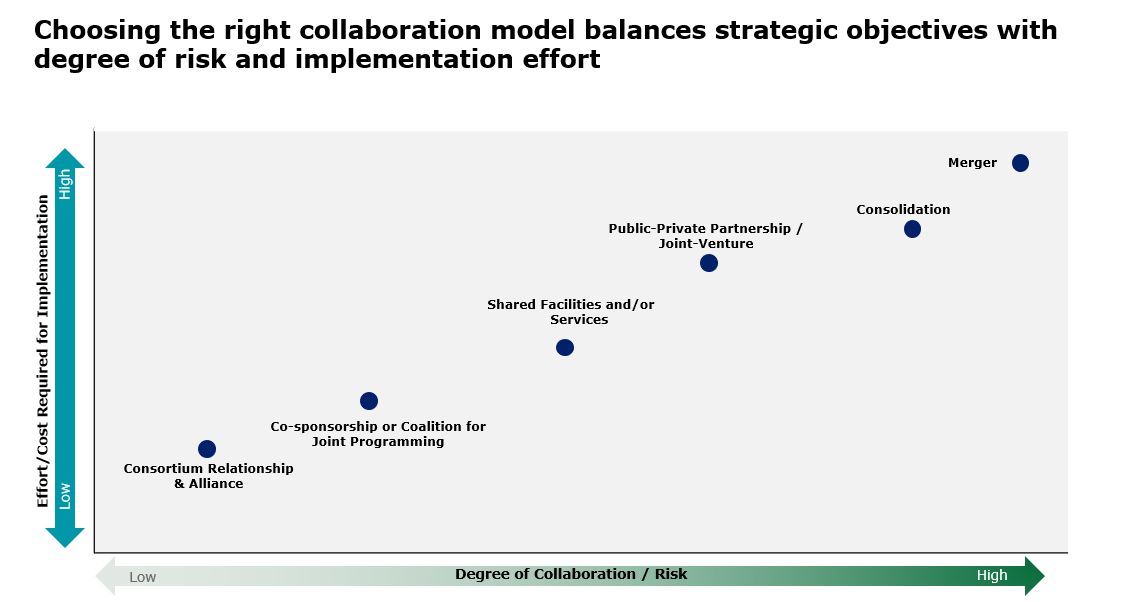
Another recent example is found in Virginia where the Carilion Clinic, which owned the Jefferson College of Health Sciences, successfully merged with Radford University. That created Radford University Carilion within the larger university and allows Radford to offer clinical-based education to more than 1,000 students in Roanoke, VA, through a public-private partnership, explains Johnston, who serves on the board of visitors of Radford University. She says the merger, announced in 2018, worked well, thanks to the leadership provided by the heads of each entity. Key reasons for the merger’s success were proximity, shared academic interests, and interest in market growth.
This trend towards consolidation in higher education continues. In 2020, for instance, Pennsylvania law was changed to allow the Pennsylvania State System of Higher Education to consider consolidation and mergers after a decade of declining enrollment.
If anything, COVID-19 is accelerating that trend. “The challenges introduced by COVID-19 may shift a good idea to a necessary one. Colleges without a clear value proposition and market position are most likely to need to look at partnerships,” Johnston says.
The loss of state funding, tuition, and revenue from auxiliary services such as housing and dining is requiring institutions to implement cost-cutting that in some cases is severe.
The cancellation of entire fall athletic programs (in some cases) due to COVID-19 is another huge loss of revenue for some institutions that could lead to more consolidation.
The shift to hybrid and online teaching compounds the loss of revenue by adding new costs that few, if any, institutions had considered in the past. The new costs include licensing more and different types of software, increasing network capacity, adding significant technology, and making changes in classroom spaces. COVID-19 also increases unexpected new costs for on-campus experiences and in-person classes with wellness testing requirements and other electronic security measures.
Moreover, the impact will be long-lasting. “One thing that COVID has proven is that remote is possible. I think many would argue that the remote experience in higher education was sort of obligated by COVID,” Friedman observes. While he admits the abrupt transition has had its issues, he adds, “That doesn't mean that it can't be made more positive. I think what COVID-19 has proven is that sort of geographic importance of place becomes less.”
As the semester moves forward, public universities and university systems will face a worsening crisis, their appropriations dwindling as states try to shore up revenue losses amid the pandemic and meet balanced budget requirements.
These combined factors could further push schools that were already experiencing budgetary shortfalls and declining enrollment closer to closing. However, schools that are thinking ahead could already be considering arrangements with other entities that will help them carry on their legacy of teaching, research, and community service in one way or another. “Partnerships in the form of consortia, mergers, and consolidations can potentially help with cost reduction while adding complementary services and programs,” Johnston says.



When pursued thoughtfully and carried out with careful planning and consideration, partnerships, consolidations, and even merger arrangements can enhance the mission and service of all parties involved—schools, faculties, and students.
Approaching a consolidation or merger without taking into account potential sticking points can scuttle an arrangement that would otherwise be beneficial to all entities involved. Chief among them is failing to establish leadership of the combined entity as the consolidation process is launched. Other issues can include conflicting personalities and goals between university trustees and regents from the respective institutions, as well as financial issues and protests from alumni who may not wish to support the combined entities. These are just a few potential issues, and plenty of deals fall through because of them.
Michael Hoyle, Lasell College’s vice president for administration and finance and the chief financial officer and a board member of Shimer College, has been through at least two merger attempts. In a recent, successful one, Shimer merged with the larger North Central College, and in another Lasell and Mount Ida College planned a merger, but ultimately had to cancel it. Hoyle offers some pointers on merger strategy in the The Chronicle of Higher Education’s “Mergers Can Benefit All Involved — But They’re Never Easy.”
When two boards of trustees are merging two colleges, it’s really important to have an independent third consultant or mediator who acts as the go-between, so each board is getting the same information and the same data. The weaker party needs to be told, ‘Remember why you’re in this.’
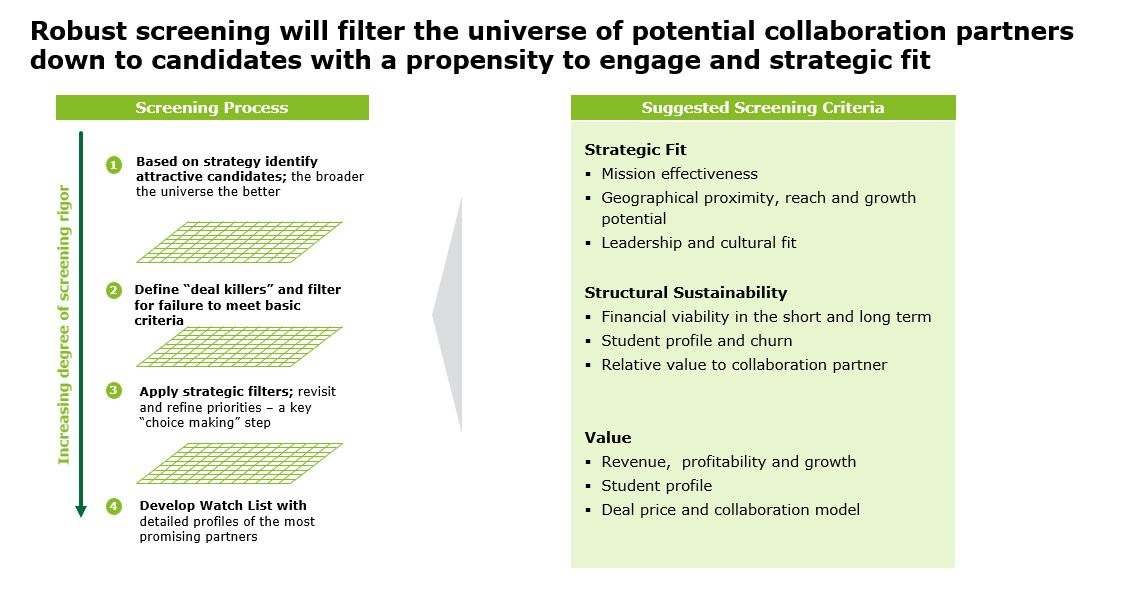
Getting an outside perspective is imperative to considering consolidations. “Institutions historically have been slow to change and, left to their own devices, are not always going to be forward thinking and sort of looking at what these challenges coming down the pike are,” Friedman says. “When you're thinking about strategic choices and where what you look like in the future might not be what you look like today, it’s really important to bring in third-party perspectives to have an understanding of what else is going on in the market that you probably don't get by trying to do stuff completely independently.”
When considering new partnerships, Friedman reaffirms the need to establish leadership. “Who's going to be in charge of the combined entity—that often is a sticking point—something that basically kiboshes opportunities to merge or consolidate or form a partnership,” he explains.
In strategizing the new relationship, Friedman observes that the parties must look at mission alignment. “You want to find a partner that is going to be aligned with your mission so that you're not asking yourself to sort of completely change,” he says.



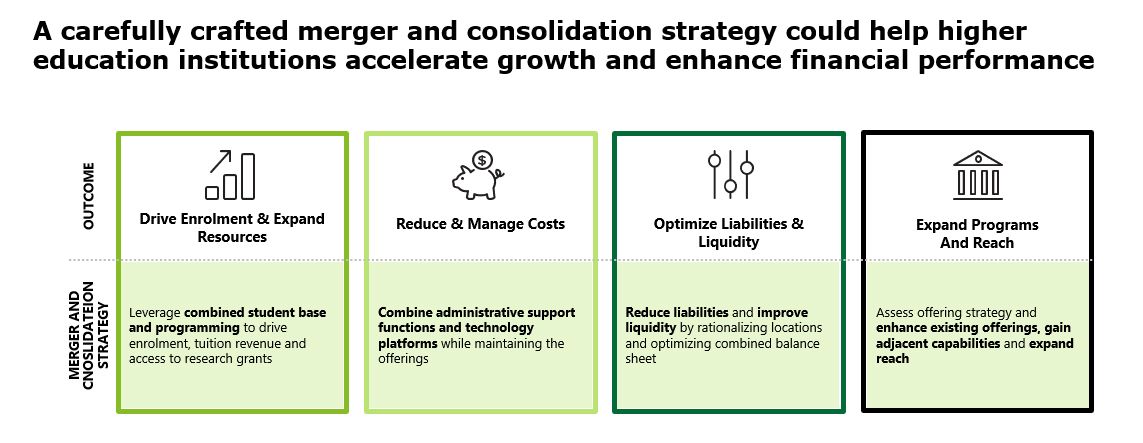
That alignment can come in the form of program opportunities in a variety of ways, according to Friedman. Program overlap can allow the institutions to take advantage of economies of scale, for instance. According to Friedman, bringing such programs together could be more compelling from an employer perspective, from a student perspective, or from a faculty perspective.
Then there are honestly places where there's potentially a programmatic hole, if you will, a need in the marketplace. As a combined institution, they have the capability to develop new programming to answer that need because now they have more scale.
Nickel also emphasizes the importance of looking at the benefits of consolidation. “It is important to reimagine what this new entity can be. I suggest it can be much more than the sum of the existing institutions. I prefer to think of it as creating something new, and making the focus of that new institution the students,” she says. “Doing that creates opportunities to increase access and reduce barriers for students. They are seeking knowledge and a degree; let’s design the university to help them get a quality, affordable education.”
Current situations don’t necessarily spell disaster for struggling universities and colleges. It presents an opportunity for change that can benefit partners working together to find synchronicity and simplification. Yes, there will be growing pains as two institutes come together in more meaningful ways, but it’s also a chance to create more resilient and relevant colleges and universities by building on each other’s strengths.
“It remains to be seen if institutions will use this crisis as an accelerant for transformation,” says Johnston.
This content was paid for and created by Deloitte Consulting LLP. The editorial staff of The Chronicle had no role in its preparation. Find out more about paid content.

 Built with Shorthand